
At last! We’ve been doing the marketing work as an artists’ co-op for over a year now but now we have the Florida art print shop up. Check it out at thefloridagallery.com


What year is this???
…and when have I even blogged recently???? Yikes! I’ve been busy though:
-Launched The Florida Gallery in July 2024
-Honored as FWC Featured Artist in Dec 2024
-Cover and feature in Central FL Ag News
-Had our first FL Gallery in person event at the Orange Blossom Revue
-Won 1st at Bartow Art League’s Alafia Rendezvous themed show
-Had a big time at my first Thomasville Wildlife Arts Festival and was invited back!
-Judged Lighthouse Art Center’s Jupiter Lighthouse plein air event
-Visited the Mennello, the Maitland Art Center, the MOAS Daytona, Vero Beach Museum of Art, Crystal River Mounds, Lake Jackson Mounds, and the Norton Museum of Art. I’ve seen and learned a lot!
-Assisted with legislative tours on both Lake Okeechobee and in the Everglades through All Florida
-Helped raise $8000 for Peace River Center through a live painting auction at their Full Moon Howl Event
-Helped raise funds for Florida’s Constitutional Right to Fish and Hunt through painting auction
-probably forgot some things, but that’s pretty on brand lol

The infamous GREEN CAKE OF GIVERNY
In celebration of the 150th anniversary of Impressionism I baked Claude Monet’s favorite cake, which he always requested from his cook Marguerite for his birthday. It’s a genoise cake with pistachio cream filling, topped with green fondant. Following the release of Monet’s Table, a book of recipes served at Monet’s home in Giverny, there was some fuss over the recipe for this green cake. The photo shows an appealingly verdant, and glossy cake, but if you follow the recipe as written that’s not what you get. You get not enough cake, flopped fondant, and loads of regret…
Monet's Favorite Cake for 150 Year Anniversary of Impressionism
Vert-Vert Cake
I tried this recipe 8 years ago with my girls. After waiting forever for the green slimy fondant to never set up I finally gave up and poured it over the cake. They dubbed it the “snot cake” and were repelled by the idea that we would venture to try it again.
I went at it with strategy this time. I doubled the cake batter and poured it in 3 pans. I made marshmallow fondant. I reverted to good old store bought green dye for the fondant (spinach slurry just wasn’t doing the job). It’s still difficult, and time consuming, but you’ll end up with the green cake that’s edible, and as close to the one Monet ate as you can get.
Here’s the recipe I derived from Marguerite’s original instructions. I can’t imagine making this by hand. So much beating. Makes you understand why it might have been a once-a-year type cake.
RECIPE:
Spinach Coloring (skip this if you like, and simply use green food dye, but I'm including it in case you want to be a purist about the flavor)
3 C. fresh spinach
½ c. water
Bring water to boil. Add spinach and blanch about a minute till bright green. Drain out liquid and push spinach through a mesh sieve (If you’re thinking mini-food processor, it doesn’t work. The quantity is too small. Just go ahead a make a mess with your sieve). It says “This will give a green puree to color the pistachio cream and the frosting,” but it won’t really.
Cake
8 eggs
1 ½ C. sugar
2 C. cake flour, sifted
4 T. ground pistachios
½ C. kirsch (I subbed apple cider with a splash of vanilla)
4 T. unsalted butter, softened
Zest of 2 lemons
Preheat oven to 300*F
Grease, line with wax paper, and flour three 9” cake pans.
Set up bain-Marie over medium heat and bring to simmer. Add eggs and sugar to heatproof bowl on top. Whisk mixture constantly until it reaches about 100*F, just warm if you put your finger in it. Remove from heat.
Beat on high with a hand mixer till the mixture turns light colored, and almost triples in volume. It should be like a soft whipped cream where it makes threads when you lift the beaters.
With hand whisk fold in flour by ½ cups. Add pistachio, kirsch, softened butter, and lemon zest. Stir well then pour into cake pans.
Cook appx. 25 min. Or until a toothpick comes out clean. Cool on racks.
Alternatively, I feel like you could use this trustworthy looking recipe from King Arthur Flour: https://www.kingarthurbaking.com/recipes/genoise-recipe
and just add 2 T. of kirsch at the end, along with the pistachios and lemon zest.
Pistachio Cream
4 T. ground pistachios
2 T. kirsch (I subbed apple cider with a splash of vanilla)
2 ¼ C. unsalted butter, softened
2 t. Spinach coloring
⅓ C. sugar (you may like more like ½ c. if you prefer sweeter deserts)
2 eggs
2 yolks
2 t. Flour
1 C. milk
Combine Kirsch, pistachios, and 2 T. butter into a soft paste. Color it with spinach coloring.
In a saucepan combine sugar with eggs and yolks, then beat in flour and milk. Cook over medium-low heat, stirring constantly until it reaches a custard-like consistency and coats the back of a spoon.
Beat in pistachio paste and remove from heat. Cool stirring occasionally. Once cool, beat in remaining butter.
Assemble cake with pistachio cream between layers, and coating the outside, and refrigerate to firm up.
Fondant Frosting
10 oz package mini marshmallows
2 T. water
5 C. powdered sugar (This is approximate. Get the big bag to be safe.)
Juice of 1 lemon
Green food coloring
Karo syrup for color glazing (optional)
Over medium heat melt marshmallows with water. Pour over powdered sugar and add lemon juice and food coloring. Stir with spatula to incorporate most of the sugar then pour out on a greased countertop.
At this point I’d recommend calling for a second set of hands because things are about to get unmanageable. Work the fondant on the countertop with a wooden spatula as it cools. This is where it relies on feel. If it’s super sticky and stringy you need to add more sugar. At this point I switched over to kneading with greased hands. You want it to be more fluffy than sticky and stringy.
When you’ve reached a good consistency, coat with oil and set aside while you clean the countertop, re-oil counter, your hands, and a rolling pin. Roll out fondant to about ¼ thickness and figure out some way to get it over the cake without tearing. Best wishes and prayers to you.
If you want that glossy green look you can brush the cake with Karo syrup thinned with just a tiny bit of water, and a few drops of green food coloring. In painting we call this glazing. Press chopped pistachios around the hase of the cake and garnish with pansies or roses on top (to hide how terribly you managed the fondant job).

Blame Marguerite if it doesn’t turn out.
I did my best.

An excellent visit with my schoolmate Shelby Little and I got to be part of her cool blog! Art, Conservation, Florida-centric reading list… Read it at link here
Shelby Visits the Studio
Working with Conservation Florida
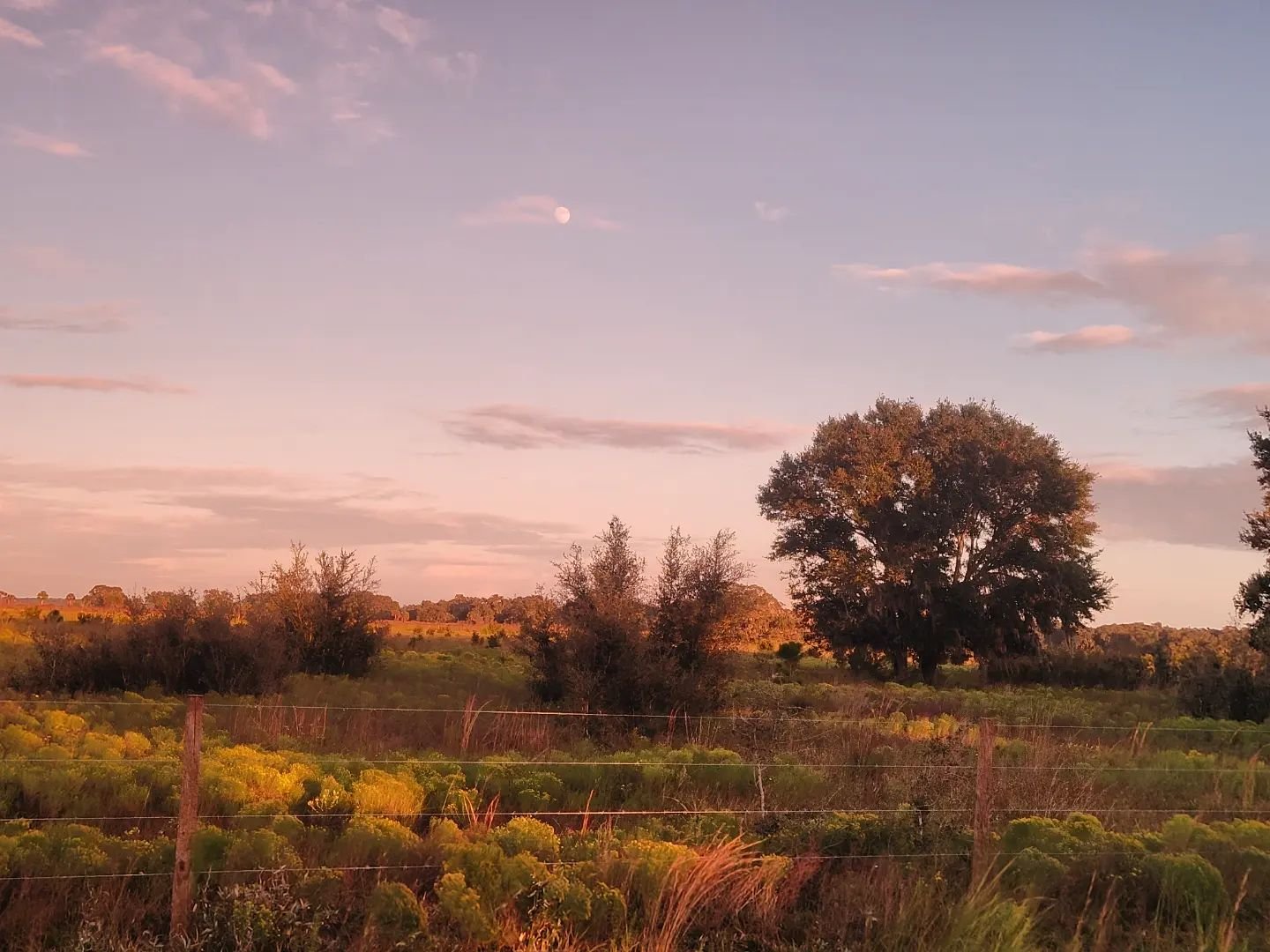
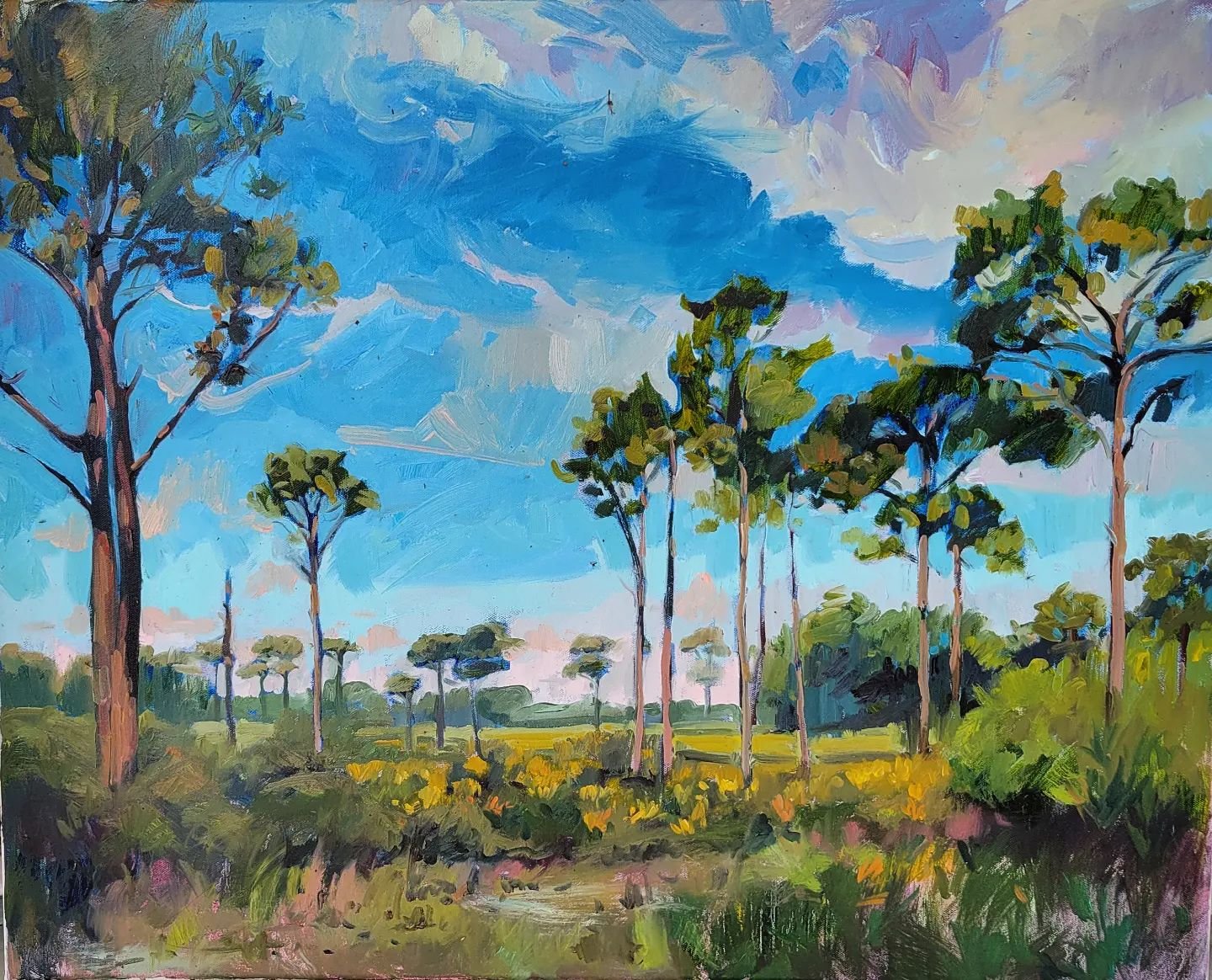
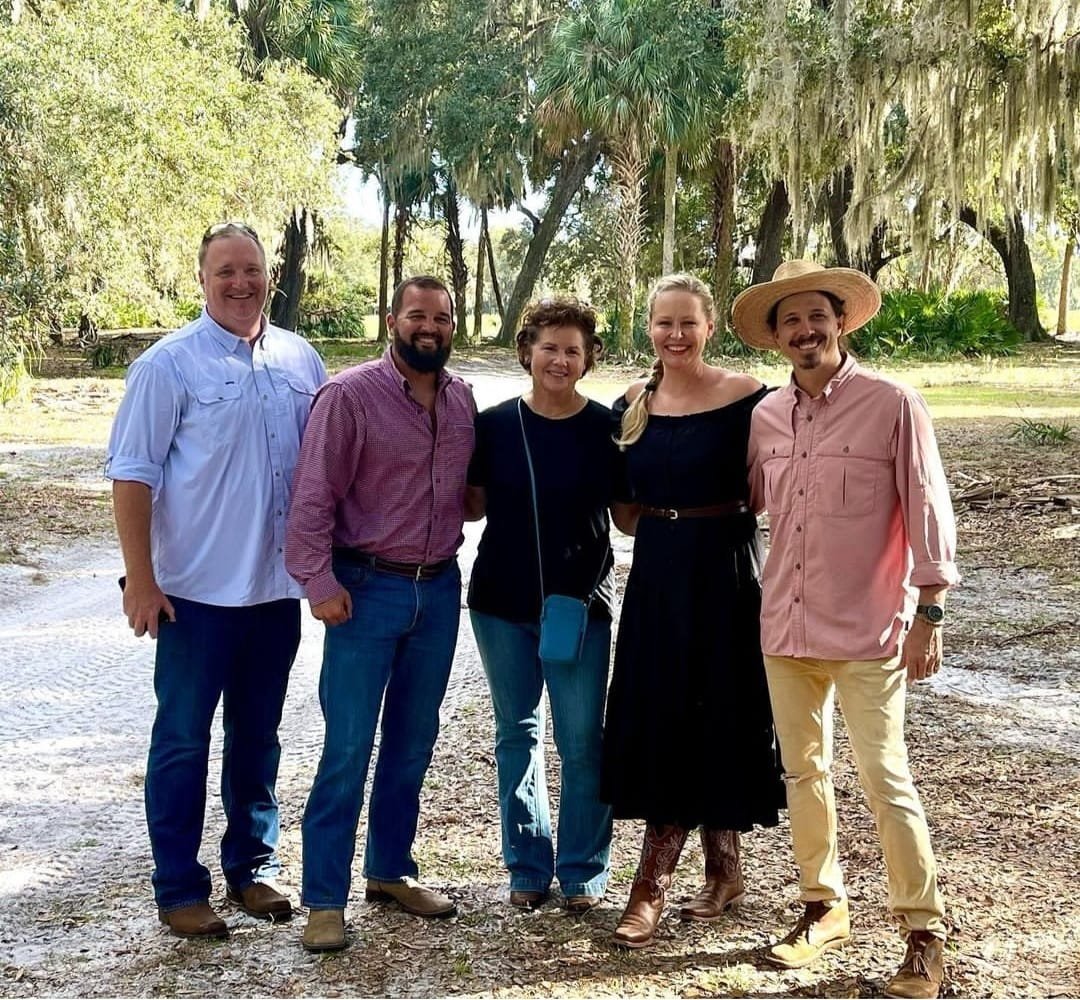
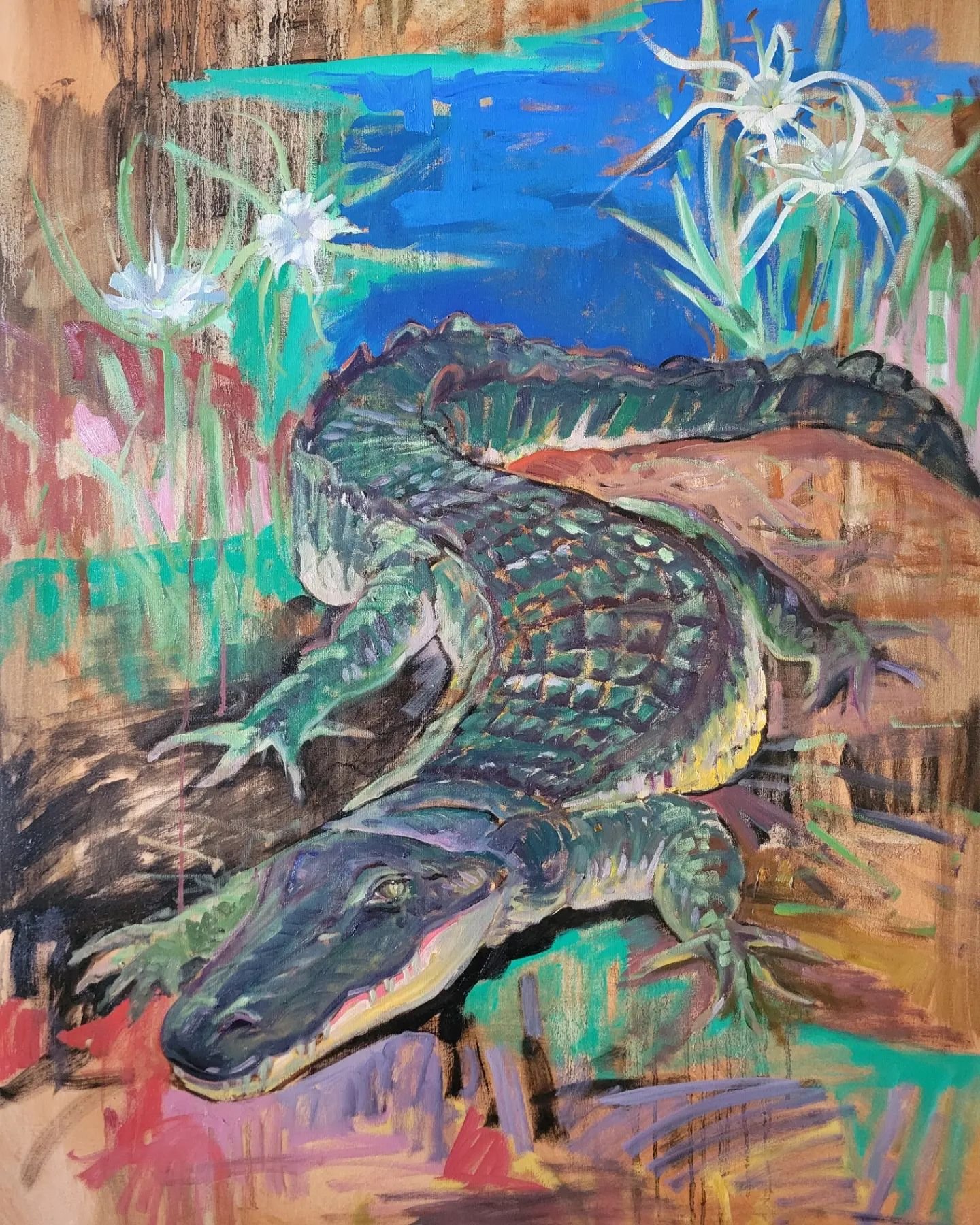
I’ve been so honored that Conservation Florida has invited me to come along for many of their outreach projects in the past year including my second time at their annual banquet on Brama Island, and a trip to Tallahassee to host Legislators at the old Capitol Building, and participation in their new series with Discover Florida Chanel called Protect our Paradise. We got a preview of the first episode at the Legislative reception and it was really inspiring. I can’t wait for all of it to be released this summer!

Remembering the Chairman, Ed Jonas
Over the years I’ve contributed a number of articles to the Portrait Society for publication in their journal, and on their blog, with the intention of posting the long forms on here. Ed Jonas was the one most on my mind when I decided it was time for an update. I know he’s dearly missed by so many, including me.
Ed Jonas is someone I had known about in a roundabout way for years. This is one of those Southern tales where it turns out everybody knows everyone, and we're all connected somehow. Ed and I didn't turn out to be distant relatives or anything, but in keeping with the thread, there were a lot of cousins involved. Earlier in his career, Ed managed the Museum of Natural History in Tallahassee where my cousin worked.
At the time, Ed was primarily known as a portrait painter. My cousin commissioned Ed to paint her two boys lounging with Duchess the Maltese. When we would visit my cousin, we all admired his beautiful portrait painting. Later when I was in college, my mother decided to have my portrait painted. When she called Ed, he was almost three years out on commissions, so he recommended Ann Kenyan, a Portrait Society member out of Jacksonville.
Skip forward about ten years, and I'm starting to look into painting more seriously. While at my first Portrait Society Conference, my mother said I should try to find the portrait painter from Tallahassee. She couldn’t remember his name, but certainly he was there somewhere. I asked around to see if anyone knew a prestigious portrait painter from Tallahassee, but everyone seemed oblivious. I couldn’t find this mysterious portrait painter anywhere. When I got home, I asked my cousin who she said his name was Ed Jonas, and I think 'that sounds very familiar.' I'm not sure at what point I finally figured out that we were talking about the Chairman of the Portrait Society, who gave talks at the conference and was hiding in plain sight and working as a sculptor. Eventually, it was all straightened out.
Through the Portrait Society and the conference, I met Charles Miano, who runs Southern Atelier in Sarasota. When he offered an Anatomy for Painters Sculpture Workshop with Ed, I signed right up. It was there I got to know Ed as a teacher. He was direct but patient and knowledgeable not just about anatomy and art, but also versed in history, science and politics. One second, he was teaching about the sternocleidomastoid, while the next he held a replica of a skull from one of Florida's native American people, discoursing on Timucuan diet and leather production and their influence on bones and teeth. Everyone spoke of him with fondness and respect.
After taking his course, I decided I wanted to sculpt a head of Osceola, the prominent Seminole War figure. I tracked down the original casting of his death bust at the Smithsonian Institute and requested permission to view, measure and photograph it. I contacted Ed about what measurements I needed. Ed came to the conclusion that I required supervision at the Smithsonian “so you don't overlook anything important.” In other words, there was no way Ed was letting me go somewhere as interesting as the Remote Storage Unit of the Smithsonian without him. It probably didn't hurt my case with the Smithsonian either saying that I was bringing along the Chairman of the Portrait Society of America.
We coordinated our visit to the Smithsonian with the Art of the Portrait Conference in DC. Ed finished the conference with a rousing closing speech, and we rushed out for our appointment. During the ride I learned that Ed was originally a medical student and had previously dissected a cadaver.
When we arrived at the Smithsonian, our guide was Dr. David Hunt, a physical anthropologist. Ed was very impressed to learn that Dr. Hunt had worked on the original Body Farm (a story for another day). The route to the Remote Storage Unit wound through many different storage areas. It was interesting and circuitous, and finally we reached the back room where there were rows and rows of busts, mostly Native American, and taken from life.
We pondered how freaked out some of the subjects must have been, knowing little if any English, and sitting there trying to trust that this white guy is not actually killing you through your face as the plaster heats up and you breathe through the straws in your nose.
Dr. Hunt had pulled out Osceola's bust in preparation and had it on a cart. Ed noted with some sadness how sunken in his face was and explained that for the last few weeks of his life, while imprisoned in Ft. Moultrie in South Carolina, Osceola had eaten only boiled eggs by swallowing them whole because he was suffering from an abscess in his throat. Ed was prepared with his own caliper and took measurements while I wrote them down. We photographed Osceola from every angle, and Ed made sure I had the right setting on my camera. I felt like the coolest, most important nerd ever that afternoon hanging with Ed and Dr. Hunt in the bowels of the Smithsonian.
Both men were genuinely fascinated by humans and their bodies. Although the conversation that day was not normal stuff to me, I felt honored that I was along for the ride with these two enthusiasts and honored to be a part of the discussion. It was like creepy Indiana Jones!
I'm constantly behind and have never gotten far on my bust project, and I regret not being able to catch up with Ed and his beloved Christine in Tallahassee. We were always in different places, but I am left with the impression that in spite of what I may not have gotten done, I was very blessed to spend one of my best days with a great man. Generous, curious, compassionate, skilled, hardworking Ed is going to be greatly missed.
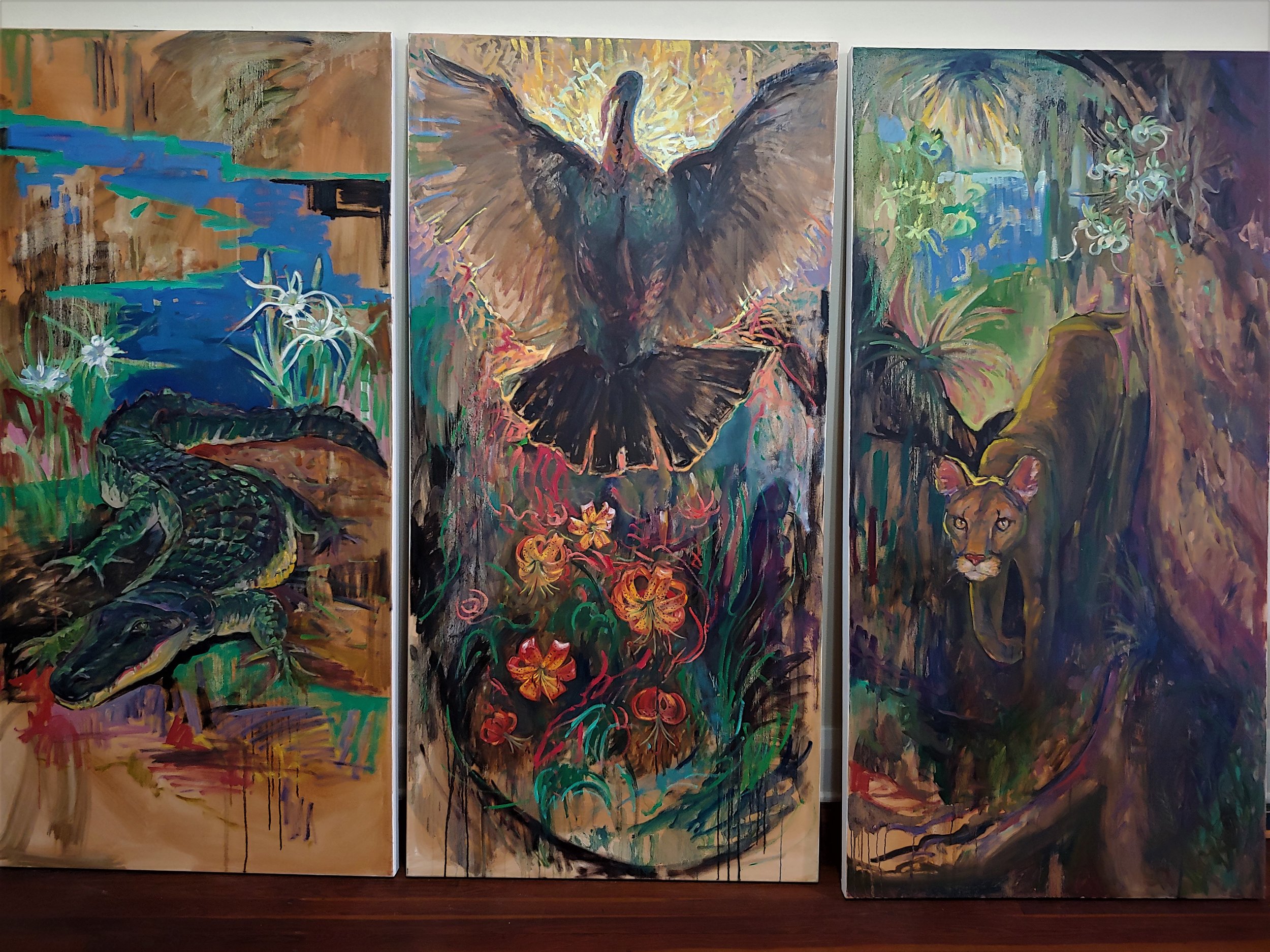
Nature Inspires Art
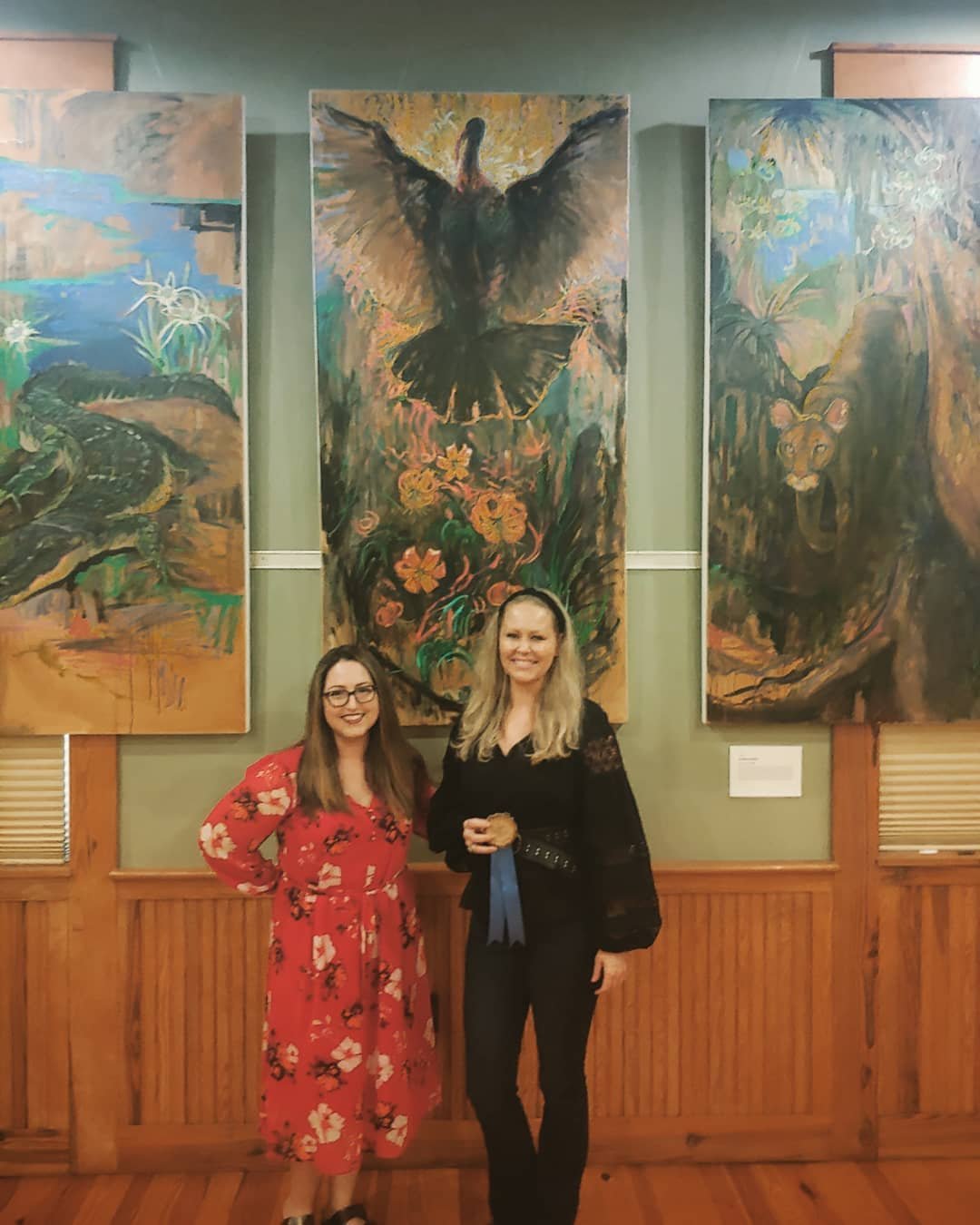
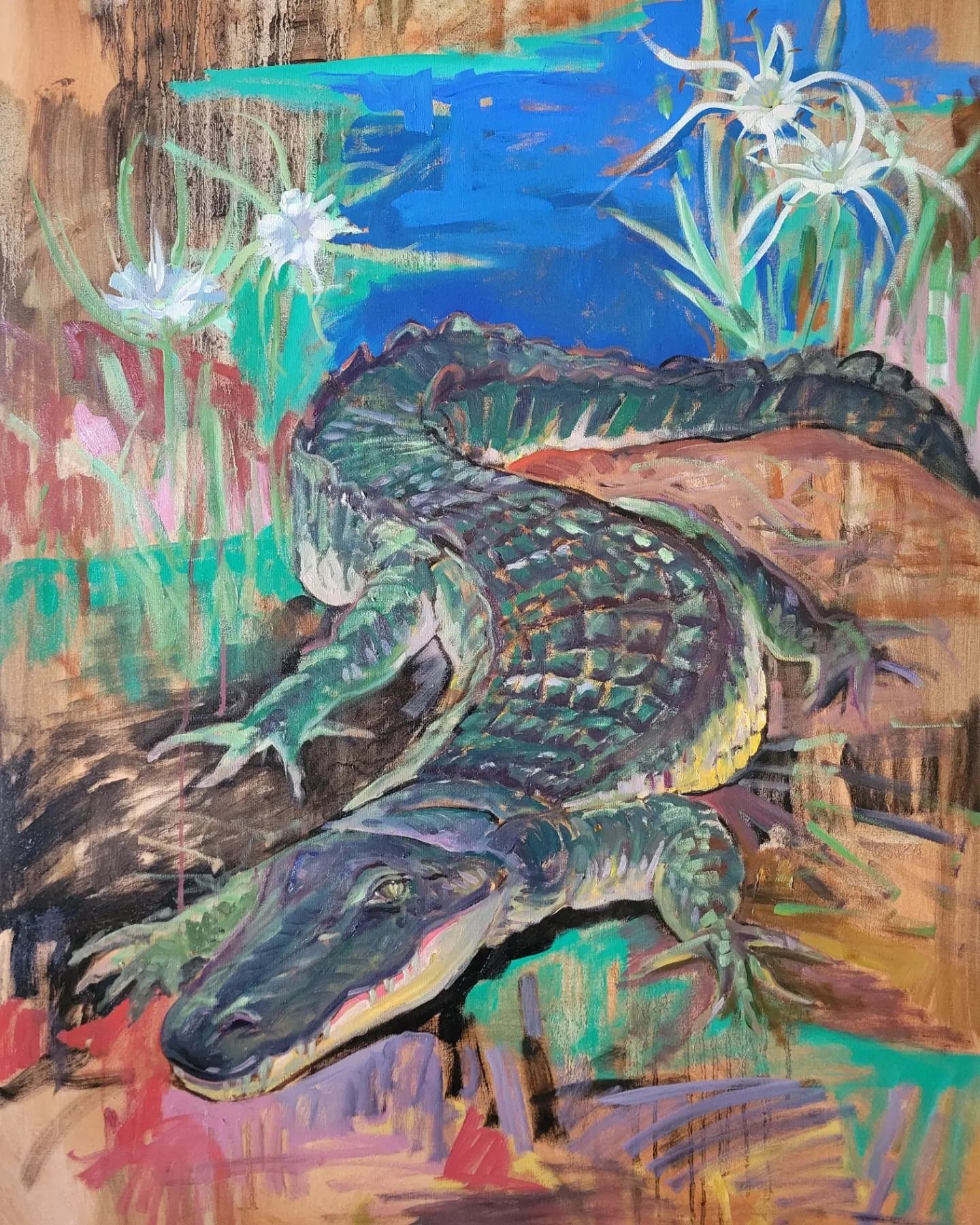
I was pleased to be awarded the 1st prize in the 2021 FL Nature Conservancy’s inaugural art show. My piece “Florida Trinity” features an alligator, an Osceola turkey, and a Florida Panther, and includes many endangered/native flora.
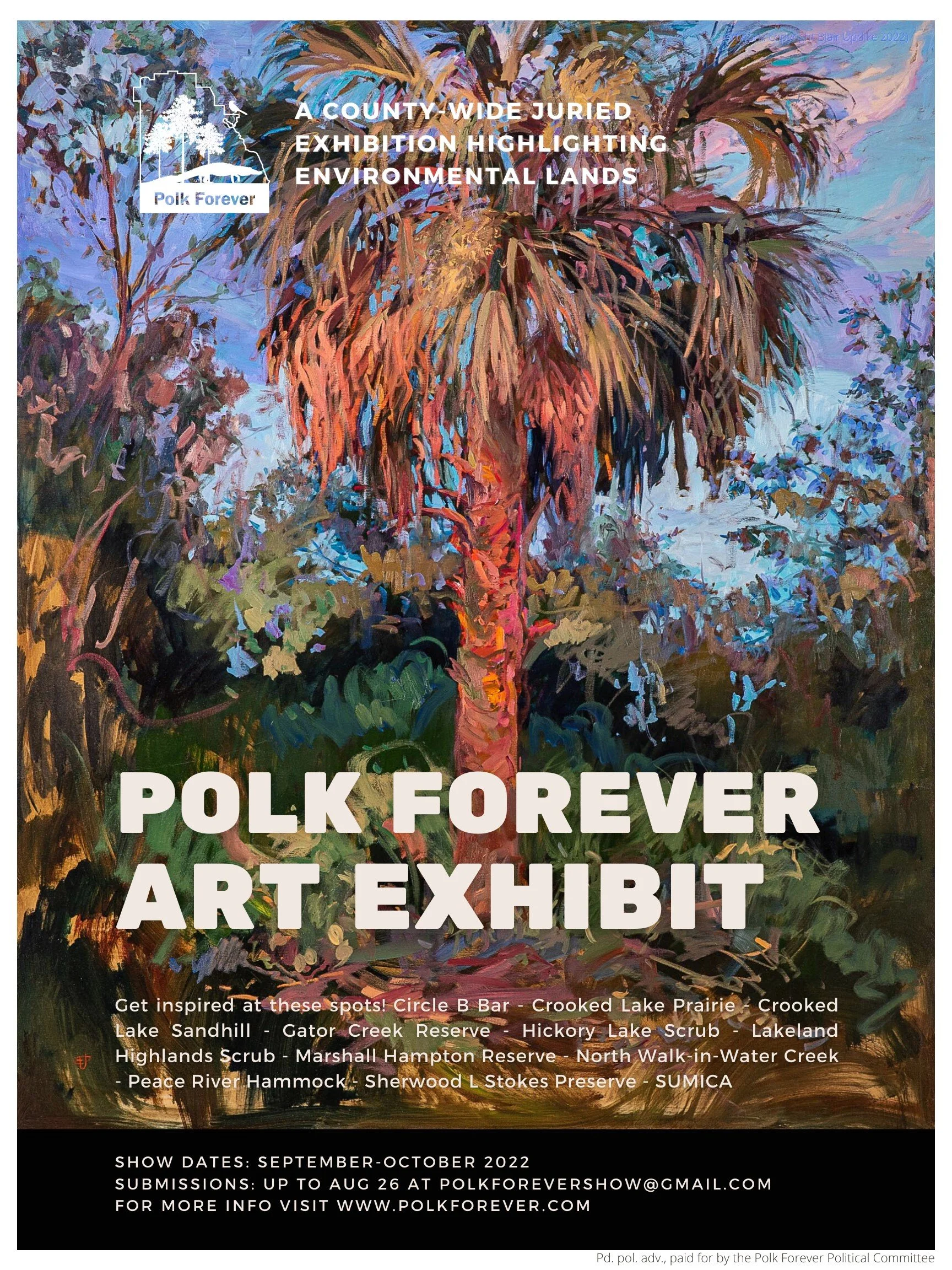
Polk Forever Art Exhibits
The Polk Forever Political Committee, on which I was a board member, advocated for a new 20 year conservation funding referendum for Polk County (It passed with almost 60%! Thanks voters!). As part of our public outreach efforts, we sought to highlight the enormous success of the previous 20 year referendum by showcasing some of the lands that were saved. We invited artists to get inspired at these sites and submit their creations for art exhibitions.
I coordinated juried art shows at 3 gallery locations throughout the county, and we hosted 3 openings within a two month period. It was a great experience. I met so many cool people. And I never want to do it again! Three shows was a lot!
Feature in International Artist Magazine
Big news! My painting of Wakulla Springs was a finalist in International Artist's rivers competition. Very cool to be recognized by this publication.


Taking this opportunity to inform an international artist about Florida history and ecology in a very limited amount of words.
Best of Show at Ridge Art
I was so pleased to receive Best of Show at Ridge Arts Association at their annual Juried Show.

Unfortunately I had to miss the reception but Christy was kind enough to get a pic with me when I went for pickup.
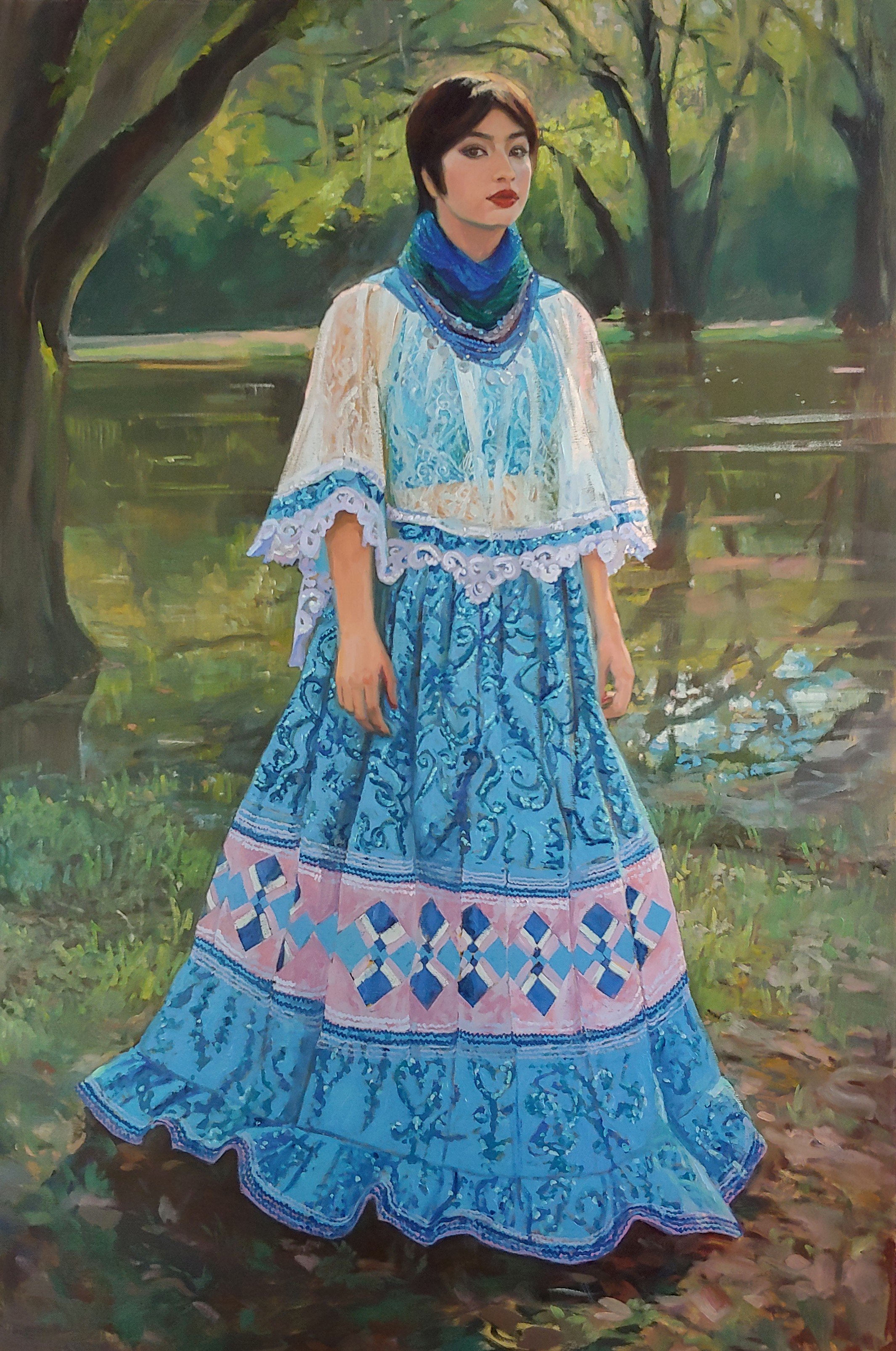
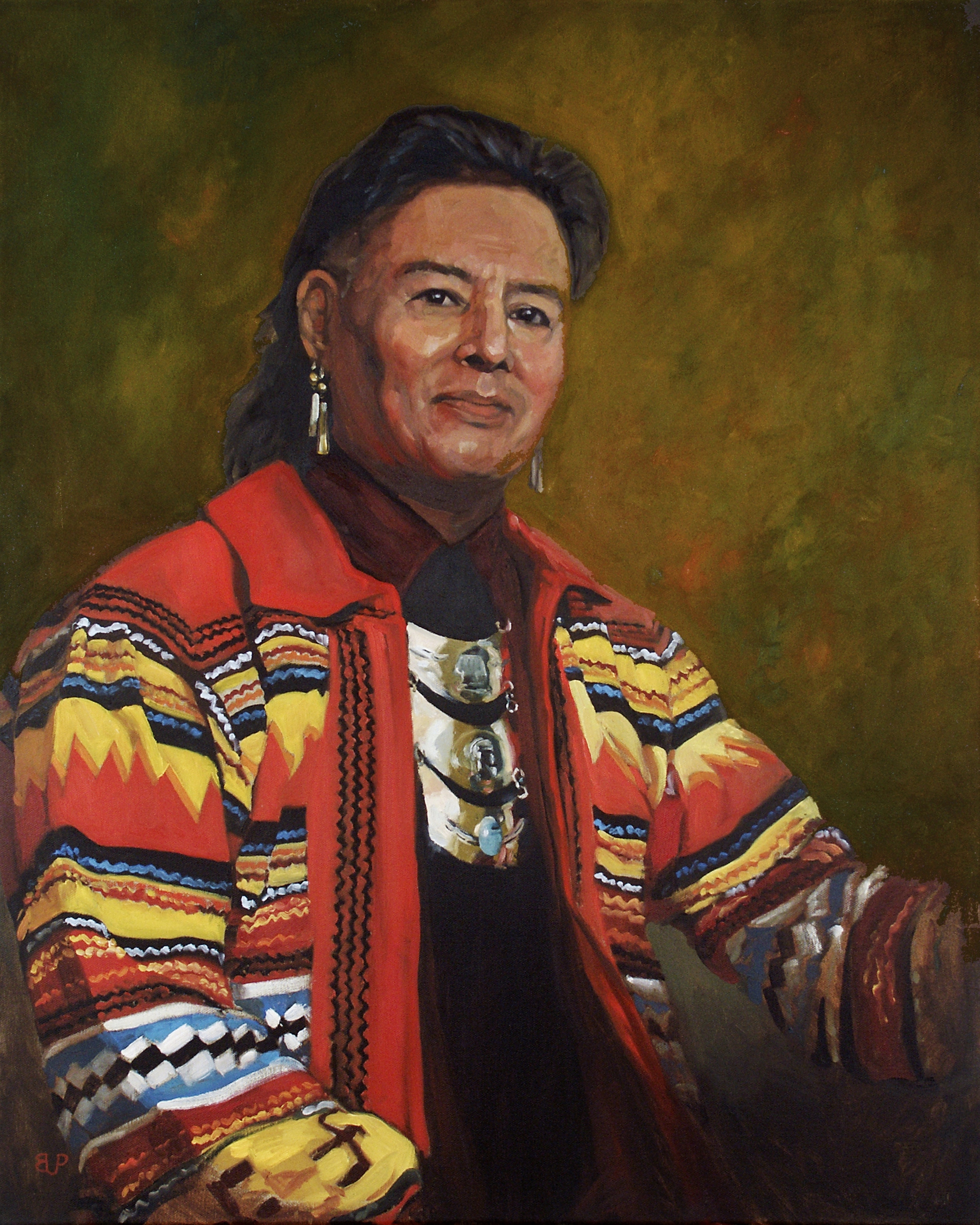
The prize was for my portrait of Durante Blaise-Billie who just finished serving two years as Miss Florida Seminole

Photo credit Beau Williams JUSTBEAU2020
Haven Magazine Feature
Blair Updike “Orange & Oil”
“Lake Wales artist Blair Updike draws inspiration from her home. Florida culture, cowboys and Seminoles, even modern-day authors inspire her to illuminate the beauty and history of the region. Two years ago we met in her studio off of Lake Amoret to discuss her work. As her painting exhibition of Florida landscapes is opening later this month at the Lake Wales Arts Center, it seemed fitting to revisit her story….”
Thanks to Tara Crutchfield for the lovely write up. Click here to read…


WH Magazine Feature
“In the fifth grade, Blair Updike created her first painting — a horse. She did this while attending a summer art camp. Her first impression of this experience? “Frustrating,” Updike admits. She then recounts a phrase her teacher frequently said to her, though: “When you’re frustrated, it’s because you’re learning, and that makes it a positive experience.” Updike’s journey as an artist has encompassed much of this tension — the process of working hard while reaping the benefits of not only a finished product, but also unexpected lessons learned along the way.”
with PHOTOGRAPHY BY NAOMI LYNN VACARO
Paint the Town Marble Falls TX
Painting a Charming Texas Hill Country Town at the Peak of Bluebonnet Season
I had a wonderful time participating in Paint the Town this year. This was my first plein air event ever. I'm not ready to enlist in the plein air army yet, but this could be fun once in a while.

First day's work. I love all the roses downtown. I'm a little jealous they don't grow like this in Florida.

A hazy sunrise with bluebonnets first thing on day two. I was packing up my gear to leave the ranch at Sandy and it was so scenic that I ran and threw together my easel in the nearest patch of flowers and quickly dashed this out. I had to do a lot of it from memory because the sun moves so quickly at the beginning of it's rising.
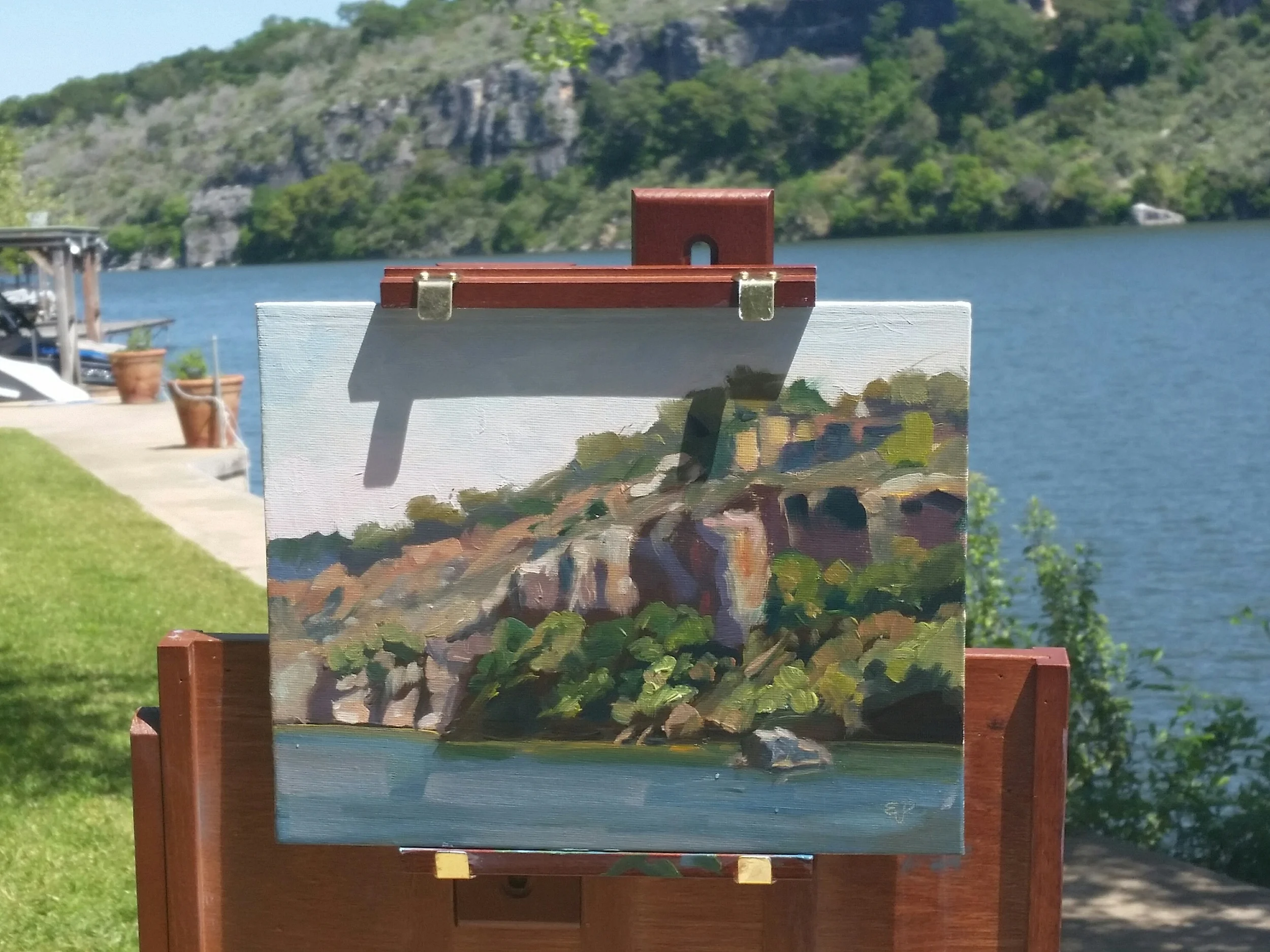
Painting two on day two. There are really cool cliffs facing part of Lake Marble Falls. I got there early and secured a patch of shade to paint in. Rocks are completely foreign to a flatlander like me so it was an interesting exercise.
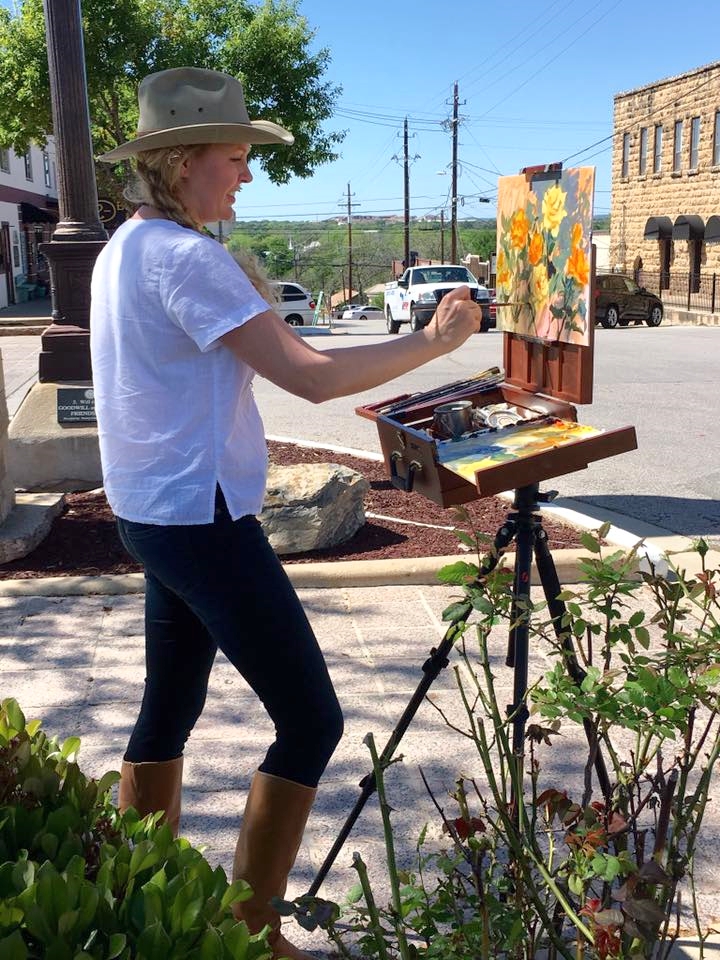
Working on my award winning painting in Downtown Marble Falls.
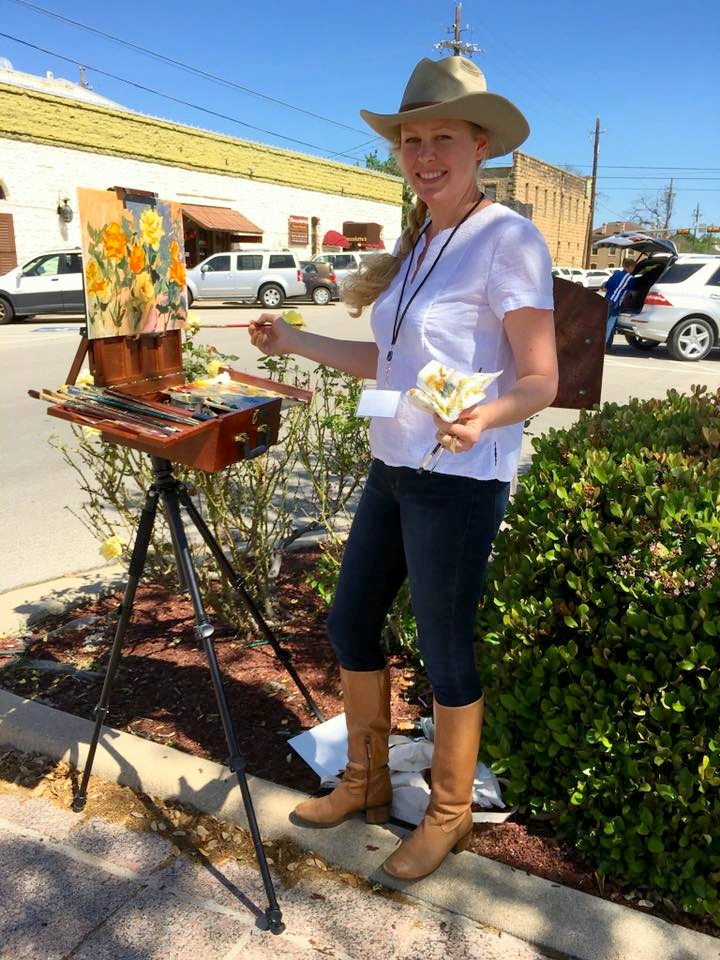
Thanks to Maria Pronske for sending me these great photos.

With award winners Robert Wilkins and Patrick Saunders. Patrick and his wife live in an airstream and travel the country following the Plein Air painting circuit. You can follow them on Instagram @pleinairstreaming. Photo credit: Debbie Slangal
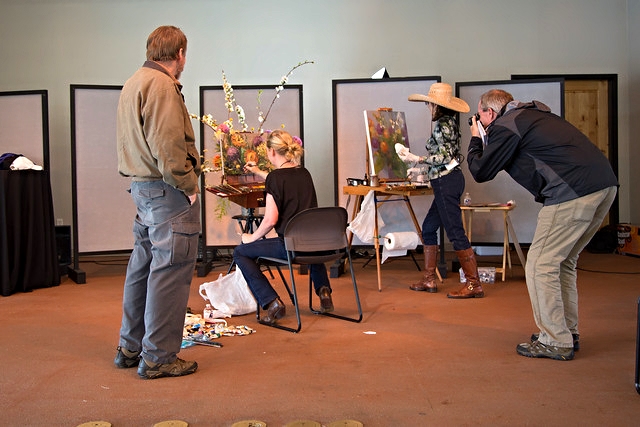
Painting a still life with the lovely Annie Nelson Sweat of Austin while the newspaperman gets shots. Photo credit: Debbie Slangal
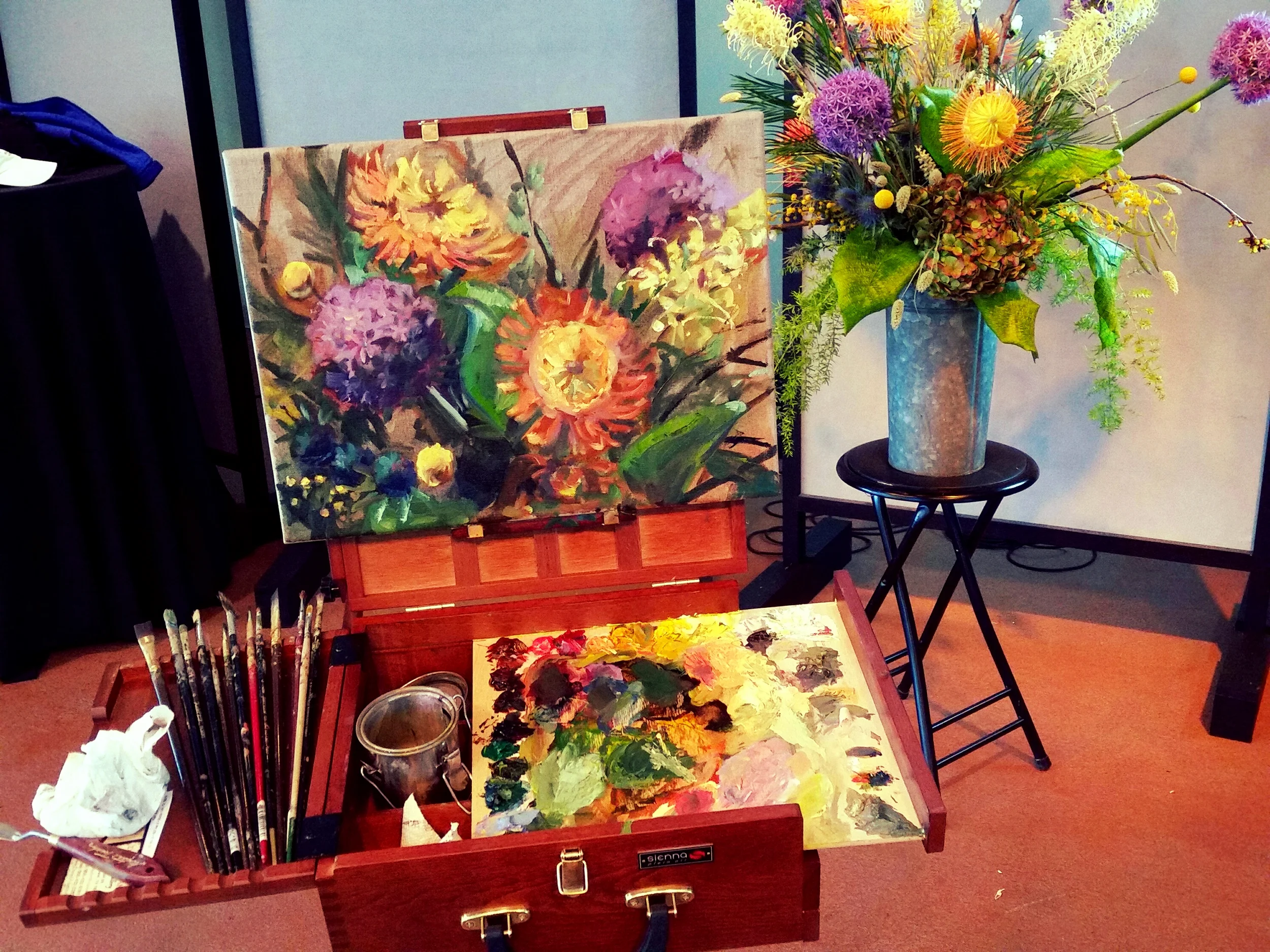
Day three was a bit dreary and I'd already completed my entry for the competition so we passed the time with a little still life demonstration.

With my ballerina during the face-off alla prima portrait painting event. Photo credit: Debbie Slangal

No this isn't some secret trick that helps me paint better. Things get a little blurry past 3 feet and I couldn't find my other prescription glasses. Photo credit: Debbie Slangal

Boss lady and wonderful hostess Janey Rives standing in for me since I had to return to Florida. Thanks to judge John Potoschnik for awarding this work 1st place! Photo credit: Debbie Slangal
Painting Osceola
My Introduction to the Seminole Tribe, Past and Present

The Chalet Suzanne
I became acquainted with Mike Osceola and his partner Brian during the final days of the Chalet Suzanne, a Restaurant and Inn founded in 1931 by Bertha Hinshaw. Mike and Brian were patrons of the Chalet for over 27 years and I’m related to the Hinshaw clan on my father’s side, so we were all there to close the old girl down. Her wake included a string of nights in the Little Swedish Bar with family and close friends. You can only squeeze about 15 people into the small sunken room, so it was pretty hard for the tall blonde and the guy with the Mohawk to miss each other.
I told my cousins how handsome I thought Osceola was and that he would make a fantastic portrait subject, so while he was away one of them broached the question to Brian, who thought flattery would be the most likely way to convince him. Osceola returned and we spoke briefly about the possibility of me painting his portrait, but he was keeping quiet and noncommittal until we discovered that we had a mutual acquaintance in Pedro Zepeda, a master of traditional Seminole arts. I took ceramics with Pedro in college, and he is well known amongst the Seminoles because he is such a force in preserving traditional crafts like canoe making. I mentioned that I’d been trying to catch up with Pedro at reenactments with the thought of doing his portrait. At that point Osceola grew about 4 inches taller and declared that I must do HIS portrait. Thank Goodness!

The Great Osceola
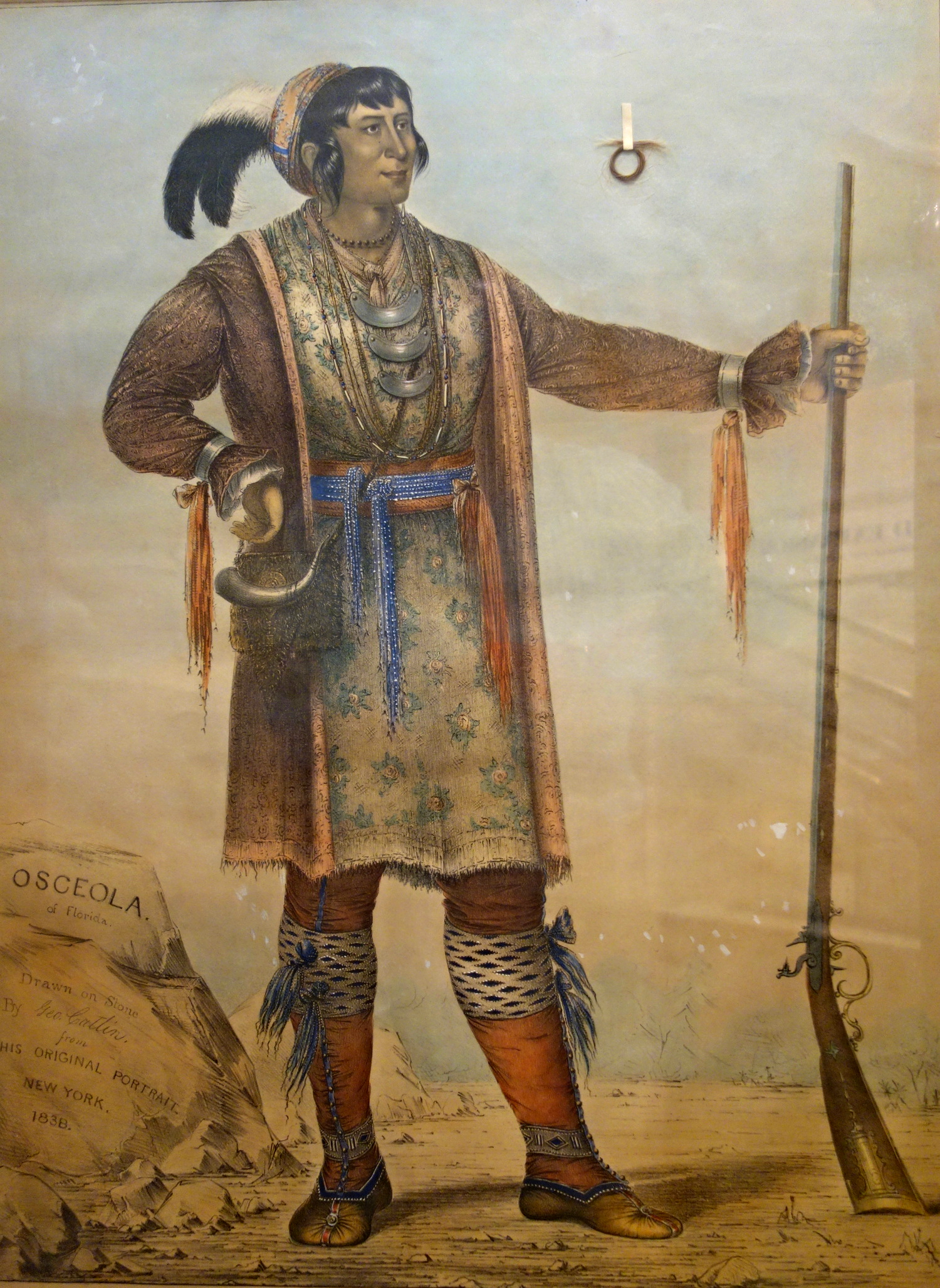
Mike Osceola’s 5th or 6th Great Grandfather was the famous leader of the Second Seminole War Asi-Yahola or Osceola. His name Asi means Black Drink, a purgative used by the Seminoles during the green corn ceremony in the summer and Yahola is a call to the spirits (referring to the cry that followed the black drink). George Catlin painted a portrait of Osceola in 1838 while he was imprisoned in Fort Moultrie, SC. Osceola had been captured under a white flag and was transported to Ft. Moultrie where he died just days after his portrait was completed.
Mike really loved this portrait, and his features clearly resemble his ancestor’s so I wanted to make reference to this original portrait by using a similar background and pose. In preparation for painting Mike’s portrait I did this little study of Osceola, which I gave to Mike and Brian for their home.

A Preliminary Study
I did a second study of Mike in preparation for the painting, just to familiarize myself with his features and coloring. It also gave me a chance to think about how I was going to handle the patchwork.
Mike has beautiful features, but I wanted to make sure and show a hint of Seminole pout coming through the soft smile. I don’t know if this expression is cultural or muscular, but it’s one of Mike’s trademark looks so I really wanted to capture it in his portrait.
After completing the study I decided that Mike needed a little more space around him, which helps make the figure look more distinguished, and that I wanted his chin higher. I also felt he wasn't quite pouting yet, so that would need to be remedied in the next version.
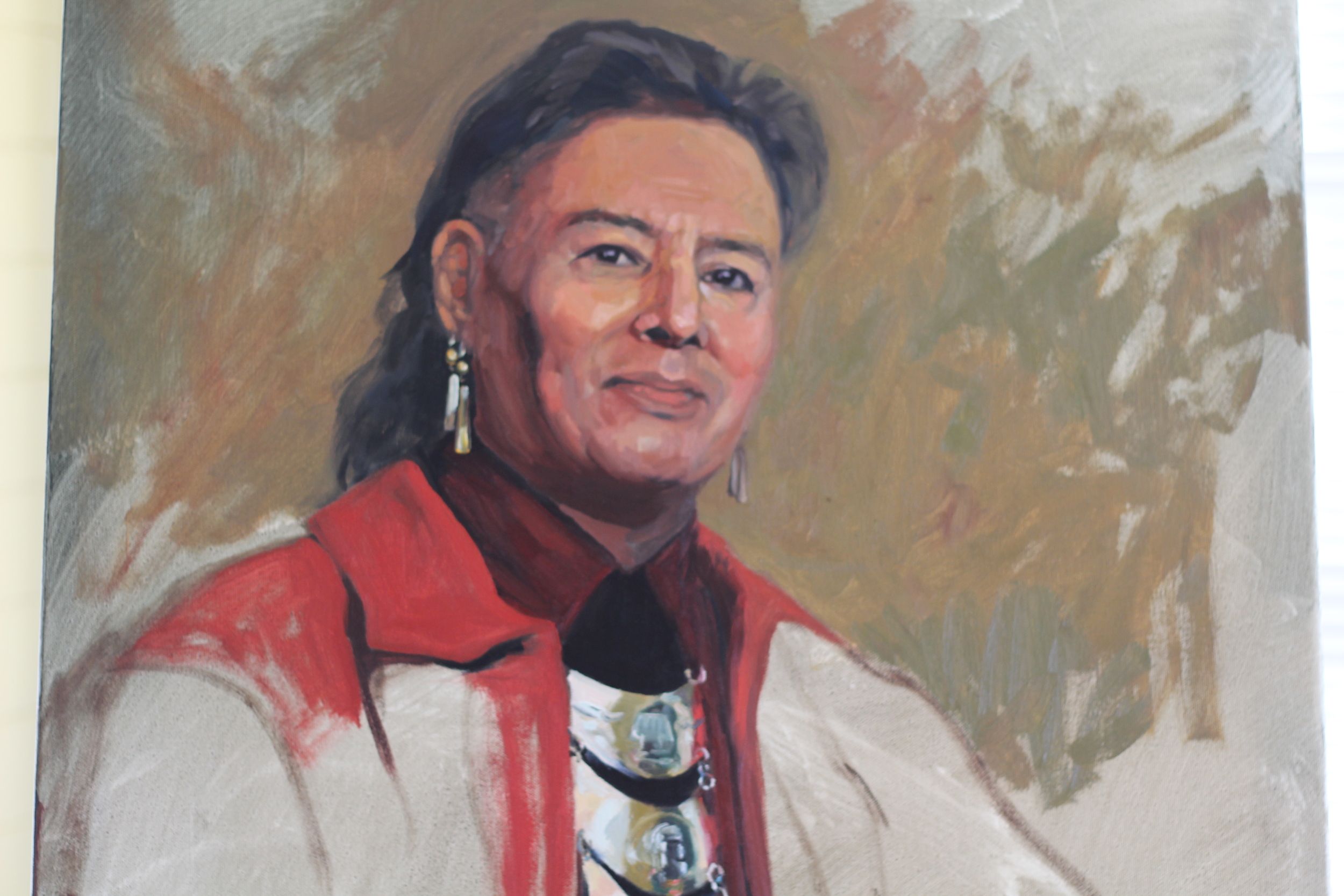
The Start
I began the official portrait by making a grisaille underpainting so that I had a guide for the position and size of the main components of the painting.
Next I worked on the face, shirt, and gorget.
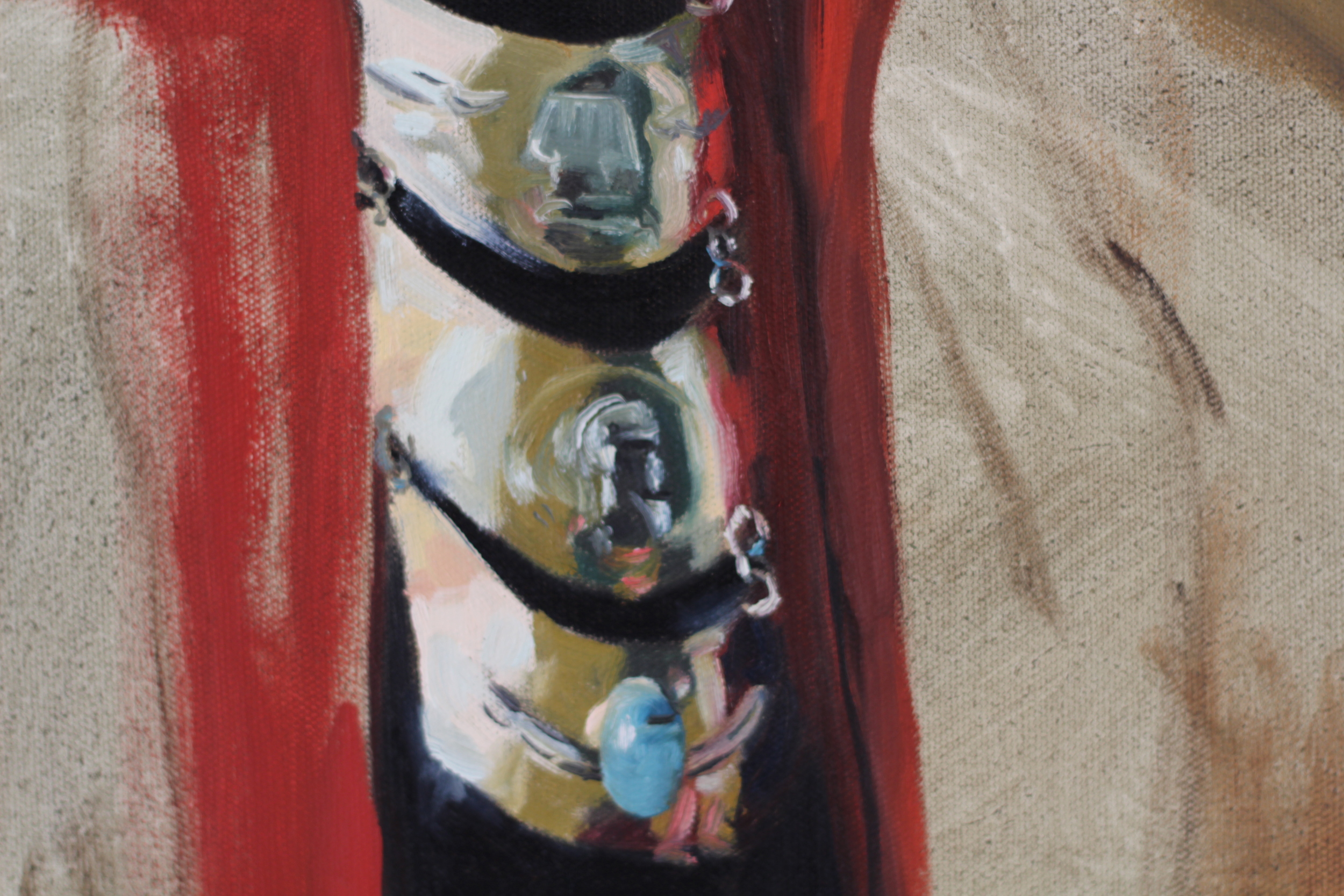
The Seminole Gorget
Mike had this gorget made in the same style as Osceola wore in his portrait. Gorgets hearken back to the days of armor, but later on became a decorative component of soldiers’ dress. It is likely that the first Seminole gorgets were given to them by the English, but later they made them out of coin silver for themselves.
The top shows a chickee flanked by otters, the middle is Osceola in profile, and the bottom is a decorative turquoise piece. Mike chose the top symbols because his clan is "Big Town" symbolized by the chickee, and he is uncle to the otter clan. Below the gorget he wore a sheer black scarf, but the portrait ended up so dark in that area that you can’t really see it.
I learned that Seminole dress was designed with the idea of keeping mosquitoes out, so it’s high around the neck and long in all directions.

A Coat of Many Colors - Cherished Seminole Patchwork
Mike is a patchwork collector and a vendor of modern patchwork, so it was important to show off the workmanship (or rather workwomanship) that went into his jacket. This jacket is vintage, a gift from his friend Deborah Wessel. The patterns have different names and significance. The two more obvious patterns on Mikes jacket are fire and water.
I must say the squiggly ric rac was not my favorite thing to paint, and I painted 19 rows of ric rac on this particular jacket in 5 different colors, so it was intense.

More About the Man
Larry Mike Osceola II is a cultural liason for the tribe and custodian of Seminole and Miccosukee items, with a particular interest in patchwork. He is on the Fort Lauderdale Historic Society Board of Trustees, an active member of the Bonnet and Stranahan Houses and most recently a participant in the Seminole Girl statue project. Mike is also an Army veteran.
Mike's father Larry Mike Osceola (aka Big Mike) was very important during the official formation of the tribe. Big Mike went to Miami High School and went on to work outside village attractions including Eastern Airlines. Big Mike was a founder and attended meetings in Washington DC during the 50's where he helped bring about formation of the tribe. In 1957 he sat on the Constitutional Committee that constructed and ratified the Corporate Charter. He was also on the council serving as Vice Chairman until 1963. So in addition to being able to wrestle alligators, and run businesses he could hold his own in a meeting.
More about the first Osceola and the Seminole Tribe
Sometime in the 1770's all indian's in Florida came to be known as Seminoles, which means "wild people" or "runaway." The Seminoles weren't really all of one tribe, but the government sort of bulked them all together because they were all in South Florida. Miami Seminoles speak Miccosukee, whereas Brighton Seminoles speak Creek.
“by the end of the 3rd war there were only 200-300 Seminoles left hiding in the Florida swamplands”
There were three Seminole Wars, the first was sparked by Andrew Jackson when he invaded what was then Spanish territory, the second because of the Indian Removal Act (this is the one during which the US Government took Osceola as a prisoner under a white flag), and by the official end of the third war in 1858 there were only 200-300 Seminoles left hiding in the Florida swamplands (Certainly there were twice as many Florida Panthers in the state as there were Seminoles). There they remained, rarely seen, until decades later with the advent of trading posts in south Florida.
Interesting Facts About the Seminoles
- Osceola was a “War Boss” not a chief. A chief isn't what you think it is. Chiefdom is not typically hereditary, and a chief is more like an ambassador. In order to earn this position they must be important, but "chief" mostly designates that they are someone who deals with outsiders for the tribe or clan. The tribe has it's own internal power structure.
- Although we closely associate the Seminoles with the Everglades, Osceola’s town was in Ocala.
- There are eight “clans” within the Seminole tribe: Otter, Bird, Bear, Snake, Deer, Wind, Big Town, and Panther. Your clan is determined by your mother.
- During the formation of the tribe in the 1950’s the Seminoles raised money through rodeo shows to finance their own travel to Washington DC during the negotiations.
- Seminoles were not Christians until the 1920's.
- Osceola's close friend was a white man names Lt. John Graham.

The Role of Modern Seminoles
I asked Mike to tell me a little about the role of the approximately 4,000 modern Seminoles living in Florida, because its not all about the FSU mascot or the Hard Rock Casino. His answer was that they are "striving to maintain cultural identity in spite of socio-economic conditions." That sounds like a line, but I learned during my trip to Big Cypress near Clewiston that it's the truth. It was a town of modest homes, the majority had a few modern toys, maybe an RTV and a shiny truck, and then there was always a Chickee.
All of these people had chosen to erect a traditional palm roofed shelter in their back yards, and there were huge ones in the common areas. So it's real. They are here to stay, and I feel like they have a lot to offer, so I look forward to a continued Seminole presence in Florida.

The Impressionist Movement and "Plein Air" Painting
Water lilies and weeping willows are what Monet made. He painted the light even when he painted the shade.
I occasionally get out in this Florida heat and paint en plein air because it really helps sharpen my eye and my color matching skills. I think many non-painters see "plein air" and wonder what exactly that means. En plein air is a french expression meaning "in the open air." This was most popularized by the impressionists.
“In early 19th century France, landscape painting was narrowly circumscribed by an aesthetic code upheld by the conservative French Academy. Painters and sculptors were rigorously trained in the Neoclassical tradition to emulate artists of the Renaissance and classical antiquity. ”
Although there were some examples of naturalistic painting in other traditions, in the all important french art world noone was allowed to paint landscapes as they were. Idealized scenes were the only acceptable mode. Impressed by the works of the English painter John Constable, some young artists called the "Barbizon School" were inspired to abandon the formalism of the past and portray nature in a more realistic mode.

An example from the Barbizon School: Fontainebleau: Oak Trees at Bas–Bréau, 1832/1833, Camille Corot.
The Barbizon painters made studies for their more finished canvases outdoors. They painted farmers in the fields, and many favored the Forest of Fontainebleau because of the wide variety of large trees growing there. The Barbizon painters were active from about 1830-1870.
The Impressionists: Color Theory Meets Plein Air
The next group of young painters came through the forest of Fontainebleau in the 1860s. Back then they had no name, and no theory beyond working in a more naturalistic manner. So they trekked through Fontainebleau and other locales to paint en plein air. Eventually with the application of new theories about light and color to their paintings they developed what came to be known as the Impressionist style.
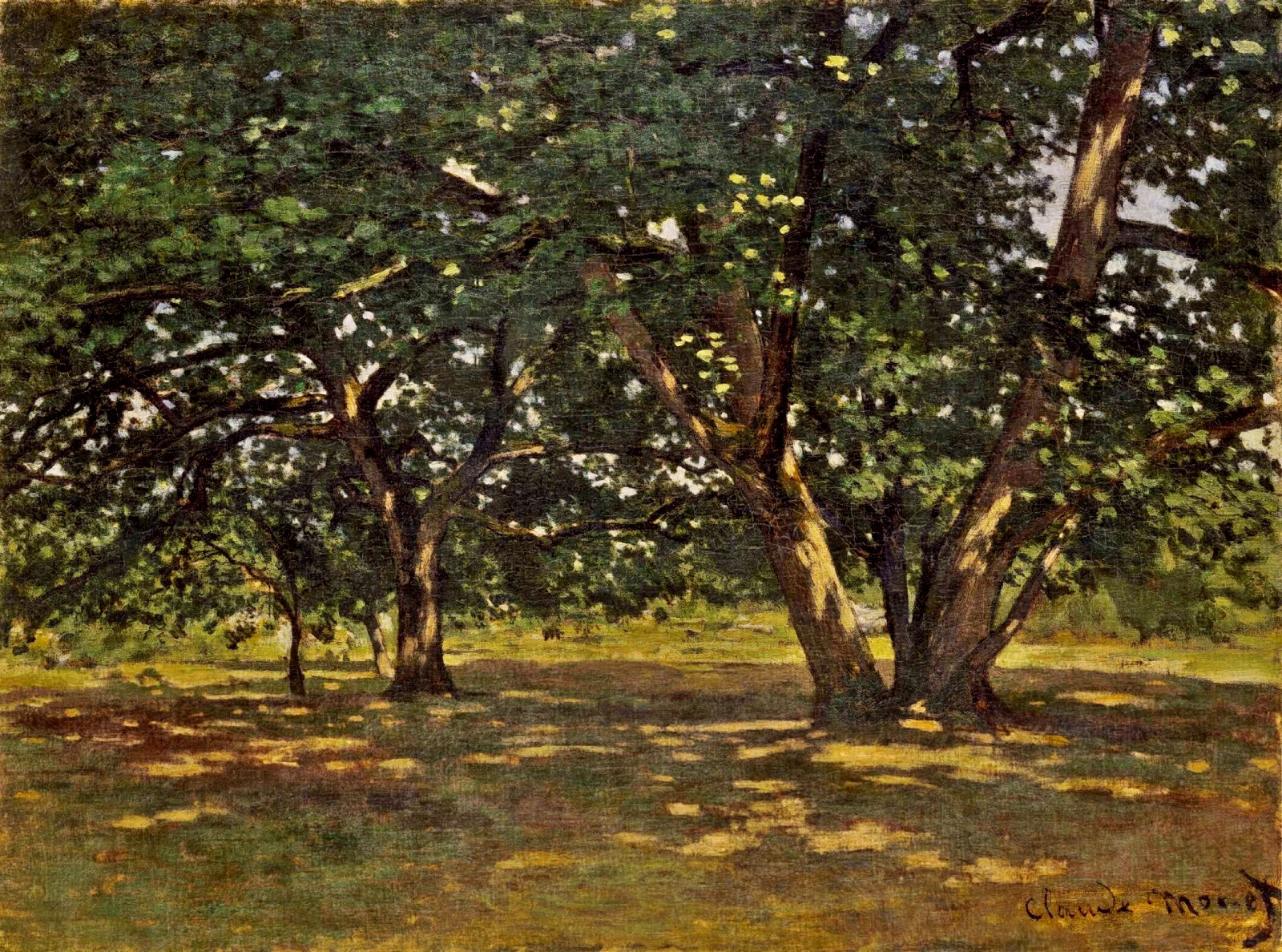
Fontainebleau Forest by Claude Monet 1865. This work doesn't resemble Monet's later impressionist landscapes at all. This is simply a realist painting done en plein air. Although Impressionists are closely associated with plein air painting, all plein air paintings are not impressionist paintings.

Impression, Sunrise by Claude Monet 1872. The Impressionist got their name from this painting. When it was first exhibited in 1874 a newspaper critic mocked the painting: "Impression—I was certain of it. I was just telling myself that, since I was impressed, there had to be some impression in it ... and what freedom, what ease of workmanship! Wallpaper in its embryonic state is more finished than that seascape." Following this infamous rant the public came to call this group of young painters "impressionists" and they accepted the label.
Impression, Sunrise by Claude Monet 1872. The Impressionist got their name from this painting. When it was first exhibited in 1874 a newspaper critic mocked the painting: "Impression—I was certain of it. I was just telling myself that, since I was impressed, there had to be some impression in it ... and what freedom, what ease of workmanship! Wallpaper in its embryonic state is more finished than that seascape." Following this infamous rant the public came to call this group of young painters "impressionists" and they accepted the label.
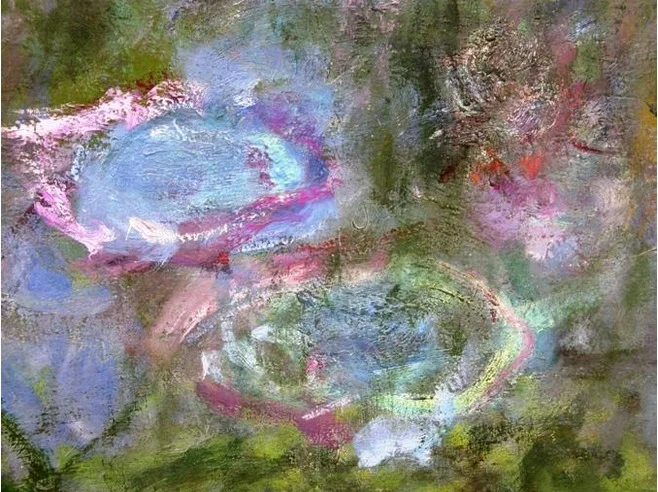
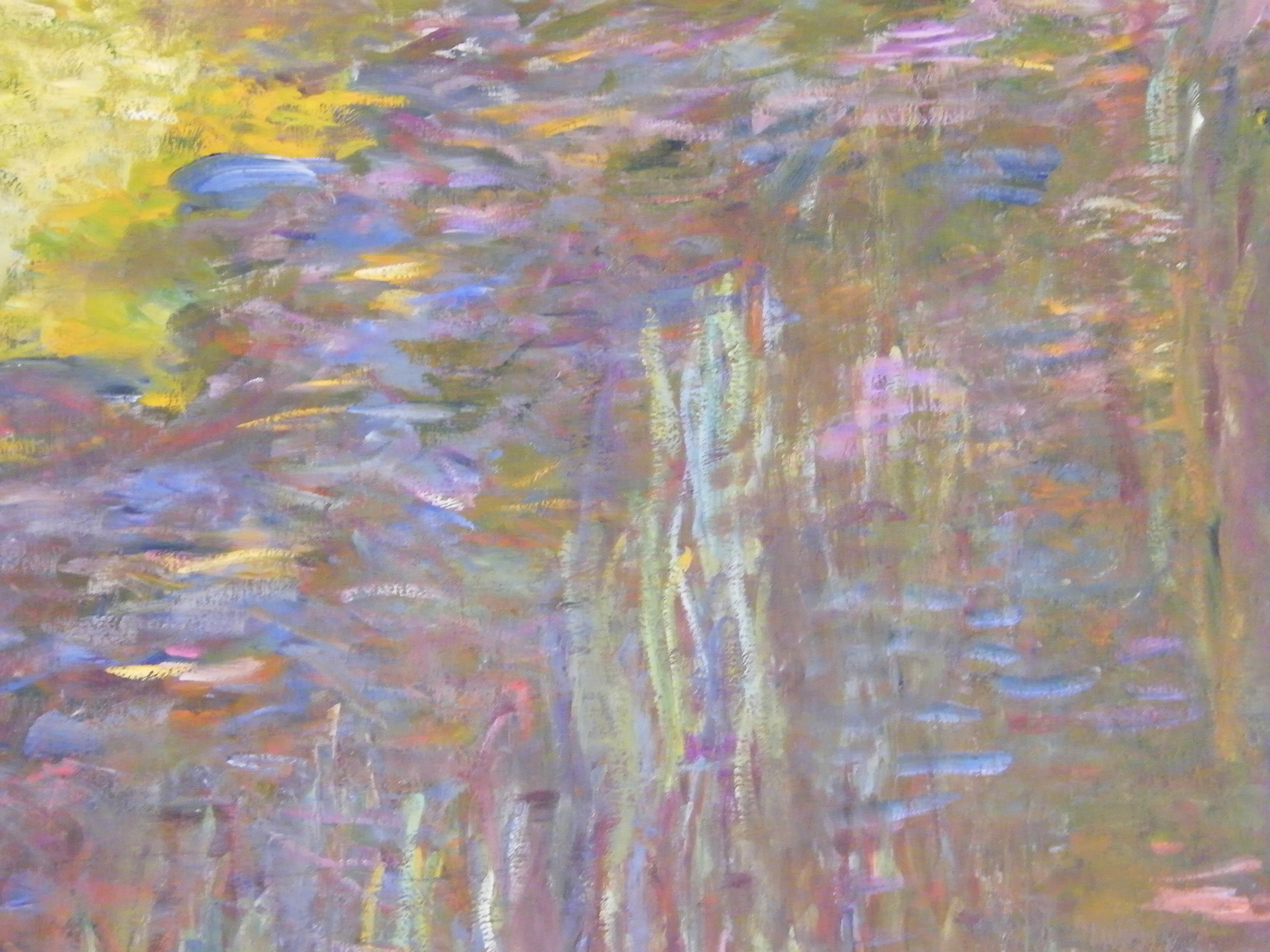
So what makes a piece Impressionist as opposed to just plein air? An impressionist painting of a landscape must start outdoors en plein air, but there's color theory on top of it. The impressionists were believers in broken color, which means that you would not make perfect blended textures. You put the paint down and leave it. By doing this you see more energetic brush strokes, but the most important part is it leaves "broken color." The idea is that if you put two opposite colors next to eachother then they vibrate and make the painting more vivid. Above are samples of some closeups of Monet's works.
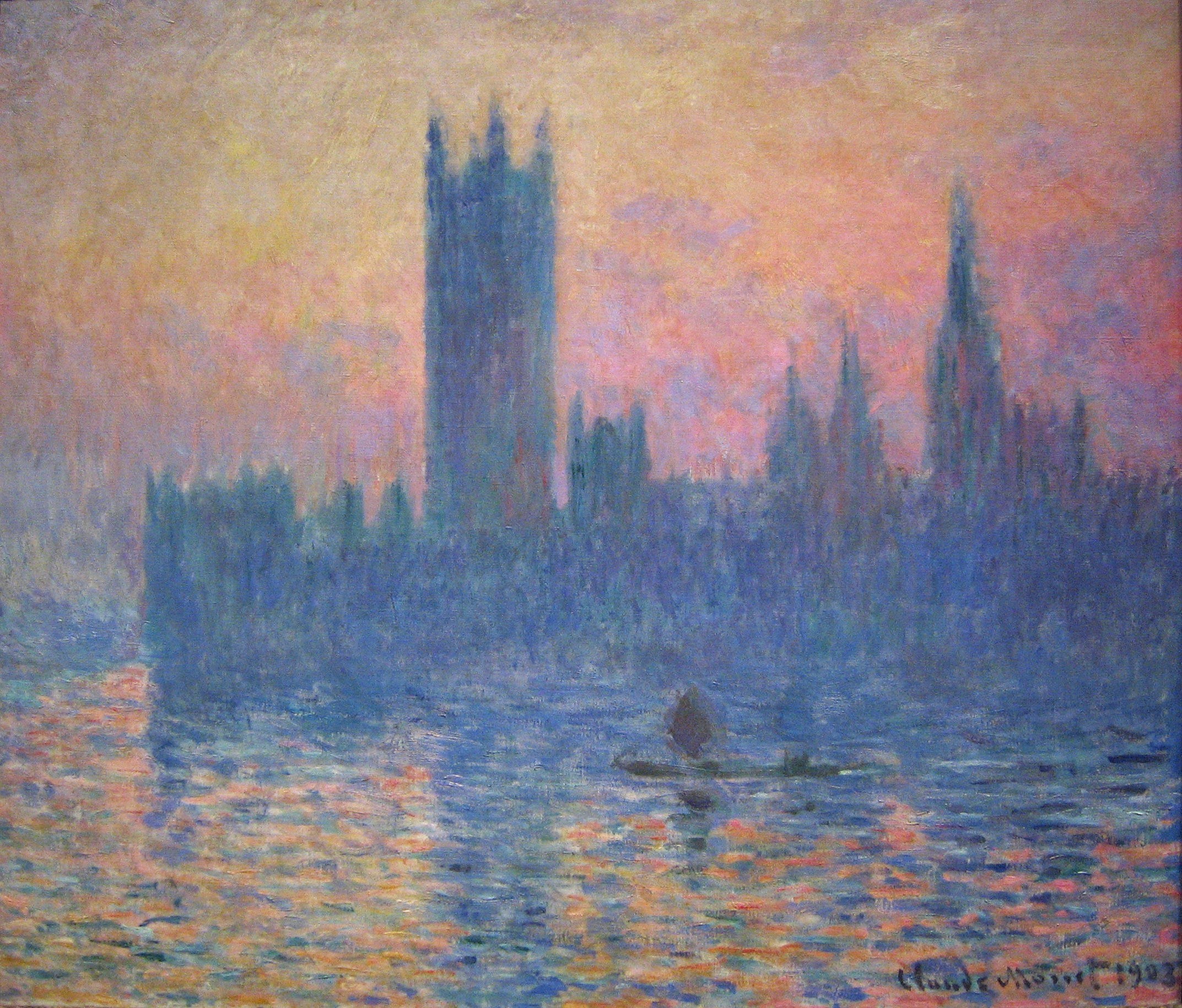
The Houses of Parliament, Sunset, 1903 by Claude Monet. In this painting you can clearly see the unblended brushstrokes, and even though this is a pretty dark scene even the darkest dark doesn't near true black.
Another quality of impressionistic paintings is that they were painting the light. This means that even if something is in the shadow it won't be very dark. These "high key" paintings hang out mostly in the mid-tone range where you can see the most colors. There's no black on your pallet if you're an impressionist. Because of the advent of commercially produced paint in tubes they had more vivid colors that traveled easily and which are readily accessible (all you have to do is squeeze more out of the tube, as opposed to grinding up pigments). The impressionists responded by applying more and brighter paint, and they could do it anywhere they wanted. It was portable.
Portrait Artists in the National Portrait Gallery
While in DC this year for the Portrait Society of America's annual conference I was able to visit the National Portrait Gallery. Not just me, they bussed around two-hundred portrait artists to the gallery. It was surreal to walk the gallery and hear well known contemporary artists such as Quang Ho, David Kassan, Burt Silverman, and Ann Manry Kenyon comment on the works of Thayer, Sargeant, and Cassatt.

This sizeable painting of H.H. Richardson by Hubert von Herkomer was completed in 1886. It was a favorite with the artists because the girthy fellow has big presence.

Trained in Paris at the Ecole des Beaus-Arts, Henry Hobson Richardson became America's leading architect in the late 1880's. He designed a wide range of structures, including churches, railroad stations, department stores, courthouses, libraries, and private homes. Best known today for Trinity Church in Boston, Richardson fused the Romanesque style of medieval France with the picturesque style popular in England and the US.

Detail of the hand.
In this portrait, British artist Hubert von Herkomer found his sitter's girth, accentuated by the rounded pitcher in the background, and ideal metaphor for his character. During the sittings, Herkomer noted that Richardson was "as solid in his friendship as in his figure. Big-bodied, big-hearted, large-minded, full-brained, loving as he is pugnacious."


This is Richardson's neighbor at the Gallery, inventor Isaac Singer of sewing machine fame, 1869. Singer's machine could sew 900 stitches per minute, more than twenty times as many as a skilled seamstress.

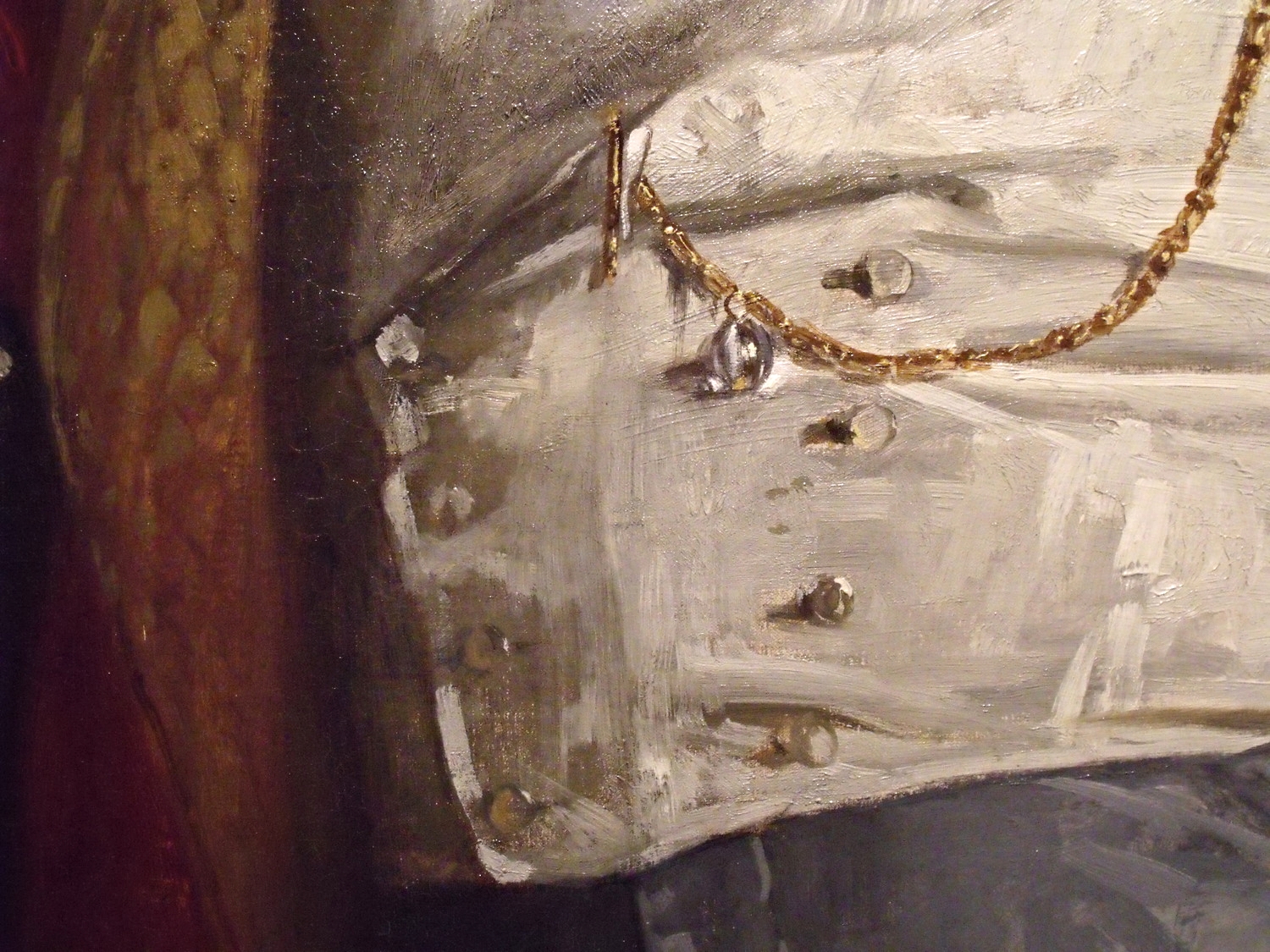
The details and variety of brushstrokes in this work are astounding.
Singer commissioned this portrait while living in Paris, after scandals about his private life forced him to relocate to Europe. American artist Edward Harrison May painted him in clothing that reflects his wealth and trademark extravagance.


Detail from Cafe at Biskra, Algeria by Frederick Arthur Bridgman. This painting is like two paintings. There's the main scene shown above, but then corridor in the background, shown left, serves as a secondary focal point. Both are beautifully painted, but I almost prefer the background.
And now for two of my favorites from the hall of musicians. "Bravo!" showcases the composers and performers who brought the performing arts to life from the beginning of the 20th century to the present.
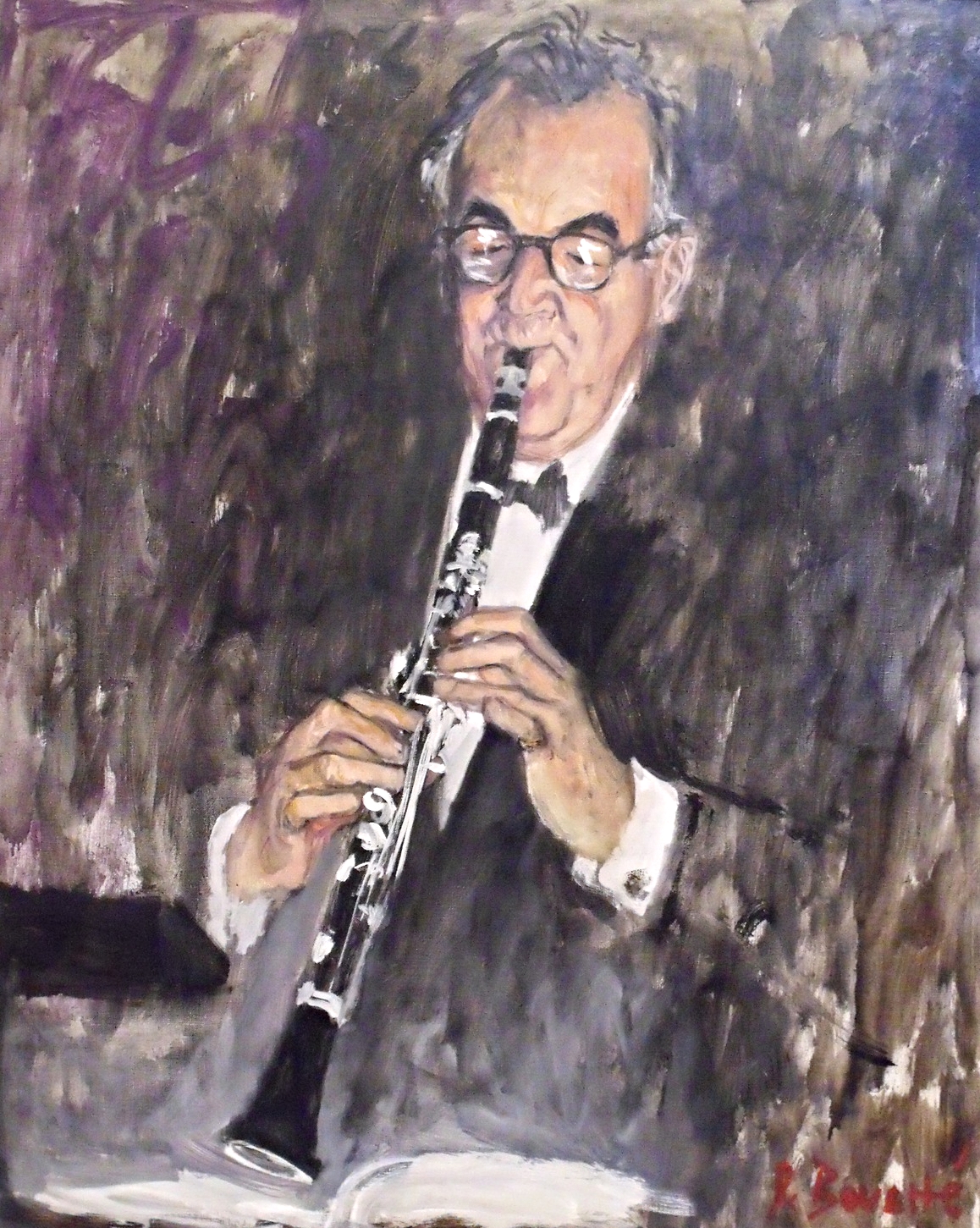
Love this one of Benny Goodman. To me it looks like he sounds.
The fellow to the right played in his band for quite a while so they sort of go together.
1960, Rene Bouche.
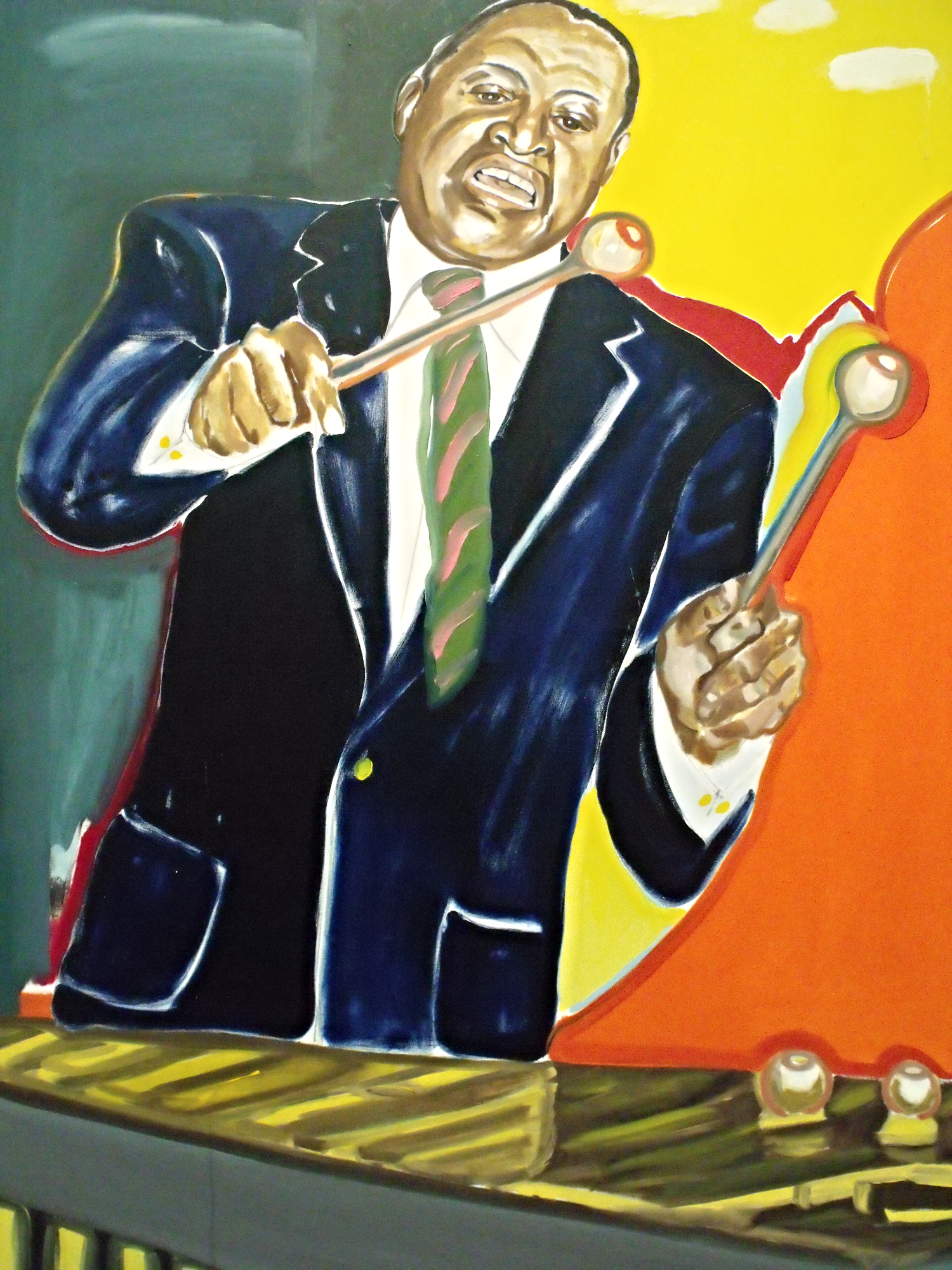
This enormous portrait of Lionel Hampton by Frederick J. Brown is 96 & 1/8" tall. That's over 8 feet!
Lionel Hampton began his musical career as a drummer until Louis Armstrong encouraged him to take up the vibraphone in the early 1930s. Hampton introduced that instrument to the jazz idiom. Hampton's high-energy spontaneity was legendary: "We got no routine," he once said. "We just act the way the spirit moves us."
I'll have to save the Thayer's for another post.